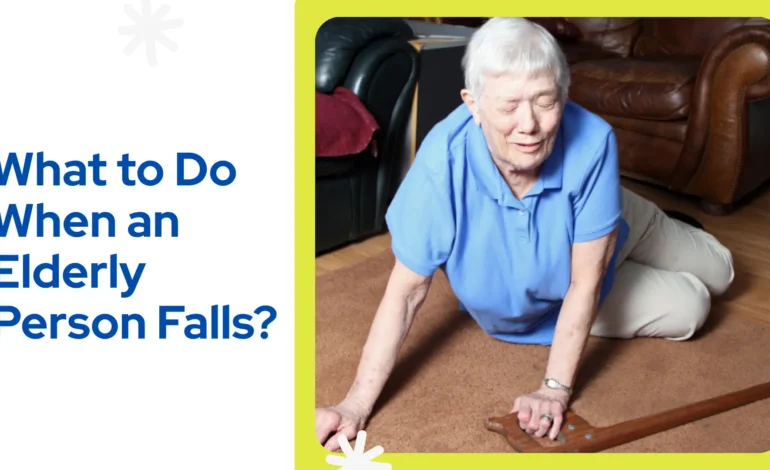
How to Help an Overweight Elderly Person off the Floor [8-Step Guide]
When someone you love is on the floor and struggling to get up, it can be frightening, and your first instinct is simply to help them feel safe.
At Gracious Hearts Inc., trained caregivers are experienced in safely assisting seniors in these situations, which ensures both comfort and safety.
That’s why knowing how to help an overweight elderly person off the floor the right way is so important to care for your elderly.
In many situations, the safest method is to help the senior sit up first, then place a sturdy chair nearby. Guide them onto their knees slowly, and support them as they lift themselves into the chair.
Keep communication calm, avoid pulling on their arms, and call emergency services if they feel pain or cannot stand.
This guide will show you exactly what to check first, how to lift safely, the body mechanics caregivers rely on, and the assistive devices that make fall recovery easier and safer.
Therefore, let’s dive into it!
Quick Safety Check: Is It Safe to Lift Them?
Before attempting to help an overweight elderly person off the floor, pause and make sure it’s truly safe to move them.
Start by checking responsiveness: gently call their name and tap their shoulder.
If they are unconscious, confused, or not responding, immediately call 911 or emergency services. This is a medical emergency.
If they are awake, quickly assess their breathing by looking for chest movement and listening for steady breaths.
Abnormal, slow, or absent breathing is another situation where you must call an ambulance right away.
Next, scan for high-risk injuries:
- Suspected head or neck trauma
- Severe or sharp pain with any movement
- Chest pain, dizziness, or shortness of breath
- Heavy bleeding or obvious fractures
- Inability to move arms or legs
If you suspect a spinal injury, do not move them.
Keep their head and neck as still as possible and wait for emergency responders.
Decision guide
- Red flags or unconscious – call 911 immediately.
- Alert, breathing normally, and no severe pain – it may be safe to assist them using proper lifting techniques.
Step-by-Step: How to Help an Overweight Elderly Person Off the Floor?
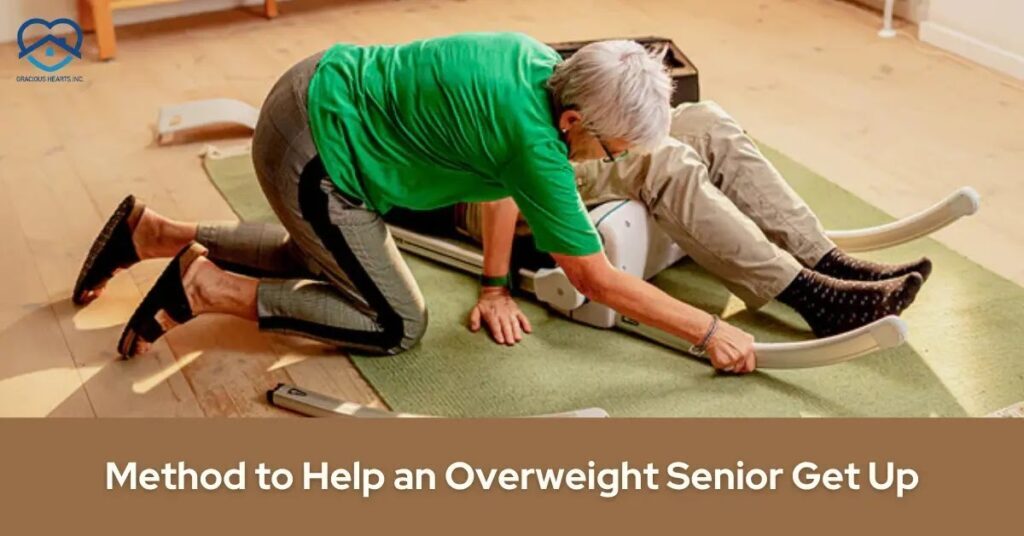
According to CDC fall-prevention principles, safe movement and transfer are critical to reducing injury in older adults.
The chair and kneel technique is the safest, coachable method for most situations.
Step 1: Prepare and Communicate
Stay calm and speak clearly. Explain each step before executing it.
Encourage slow, deep breathing to keep the senior relaxed.
Scan for any signs of pain, injury, or red-flag conditions (head trauma, neck pain, severe chest pain, inability to move limbs).
If any red flags exist, call 911 / emergency services immediately.
Step 2: Roll Onto Their Side
Ask the senior to roll gently onto one side. This reduces strain on the spine and makes the next movement safer.
Support their torso with your hands on the hips. Avoid pulling their arms, which can injure the shoulders.
Step 3: Move Into Hands-and-Knees Position
Guide them to a hands-and-knees position. Ensure their knees are aligned under the hips and hands under the shoulders.
It stabilizes the body and allows the senior to control their weight safely.
Step 4: Place a Stable, Non-Rolling Chair
Position a sturdy, non-rolling chair in front of them. Ensure it is firmly against a wall or solid surface to prevent tipping.
The chair will serve as leverage for the senior to transition into a seated position.
Step 5: Establish a Half-Kneel
Have them bring one foot forward, and keep the opposite knee on the ground.
This “half-kneel” position transfers weight from the floor to the forward leg and reduces stress on the lower back.
Step 6: Lift Using Legs, Not Back
Caregiver places hands on hips and torso to stabilize. Coach the senior to push upward with their legs. Keep the spine straight.
Maintain your own body mechanics: bend your knees, keep the weight close, avoid twisting, and never dead-lift.
Encourage the senior to move slowly, in small controlled increments.
Step 7: Sit and Rest
Once upright, guide them into the chair for a brief rest. Ensure the feet are flat on the ground and the torso is supported.
Check for dizziness, pain, or instability before attempting to stand fully.
Step 8: Stand When Ready
When the senior feels stable, they can push off the chair using leg strength. Keep arms on armrests if needed.
Offer support at the waist or forearm, and avoid pulling on the arms.
While this guide explains safe techniques you can do at home, having professional caregivers from Gracious Hearts Inc available ensures that heavier seniors or those with limited mobility receive expert assistance
Non-Kneeling Alternative (For Painful Knees or Higher Obesity Levels)
For seniors with knee arthritis, severe obesity, limited leg strength, or balance issues, the kneeling method may be painful or unsafe.
In such cases, opt for low-risk, minimal-lift strategies.
1. Sliding-to-Elbow Technique: Have the senior pivot onto an elbow, then forearm, gradually shifting weight toward a chair or bed.
2. Cushion Elevation: Place a cushion or folded blanket under the hips to slightly elevate the pelvis. It reduces stress on the knees and back.
3. Log-Roll + Two-Chair Method: Perform a log-roll to rotate the senior onto their side, then position one chair at the head and one at the feet. This allows the senior to pivot into a seated position with minimal lifting.
4. Sliding Sheet or Blanket: Place a sliding sheet under the torso to reposition the senior safely without lifting.
Team Lift: When & How to Get Additional Help
When a caregiver realizes that lifting alone could put them at risk, that’s the time to call in extra hands.
A team lift becomes essential when dealing with heavier seniors, limited mobility, or unstable footing.
Here’s a safe, coordinated way to do it: assign three roles.
A front stabilizer who handles the gait belt, a side supporter who keeps balance, and a chair handler who positions and stabilizes the non‑rolling chair.
Use a gait belt properly to give everyone a secure and ergonomic anchor point; according to UCI’s geriatric gait belt guidelines, using the belt correctly helps caregivers avoid back strain.
Assistive Devices That Reduce Risk
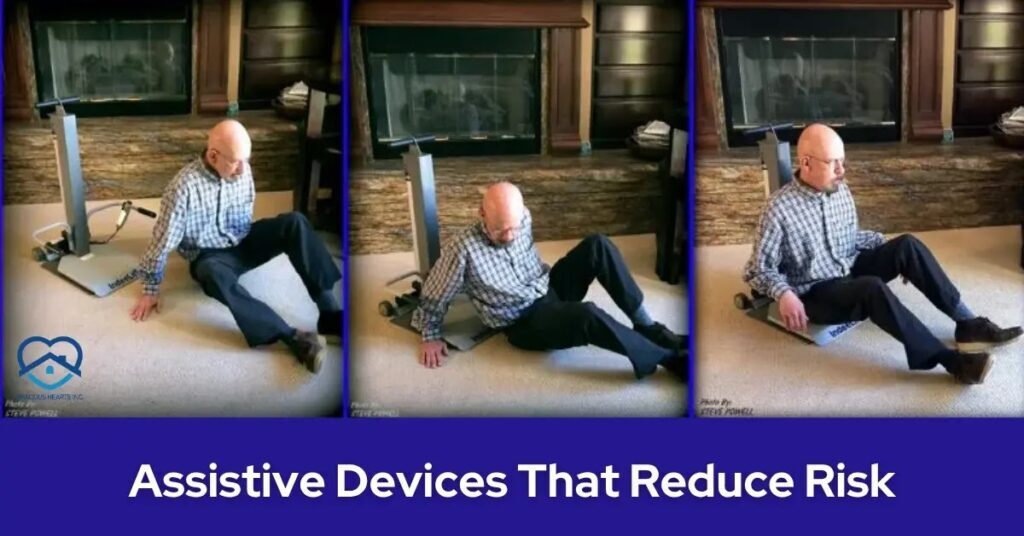
According to FDA patient-handling guidance and national fall-recovery protocols, mechanical assistance should be used whenever a manual lift could strain the caregiver’s back, compromise the senior’s spine, or increase fall risk.
Below is a clean, structured breakdown of the safest floor lift options and how to choose the right one.
1. Full-Body (Hoyer) Lifts
Best for: Seniors who cannot bear weight or need full support.
Hoyer lifts use a full sling and a manual or electric lifting arm to raise the senior from the floor to a bed or chair.
They offer maximum stability and protect both the senior and caregiver from injury.
Standard models support 340 – 400 lb, while bariatric lifts support much more. These are the devices most recommended by physical therapists and safe-patient-handling teams.
Of all the best lifts, one excellent example is the HUANUO 2-in-1 Electric Chair Lift, which supports up to 308 lb, adjusts in height from 2.3″ to 18.9″, and features a tilting backrest (140° to 93°) to maintain comfort throughout the motion.
With more than 10 lift cycles per charge, this electric chair lift aligns with FDA guidelines and is recommended by physical therapists for floor-to-chair lifts.
2. Electric Floor-to-Chair Lifts
Best for: Seniors with some leg strength but cannot transition from floor to standing unassisted.
These floor lifts raise the person from the floor to a seated or semi-standing position.
Many are bathroom-safe, portable, and easy for one caregiver to operate. They are popular in home care settings where repeated lifting is required.
One strong example is the MAIDeSITe Electric Chair Lift, which supports up to 300 lb and extends up to 20 inches high.
Its high-strength steel frame provides stability, while IPX8 waterproofing and six suction cups enable safe use on wet surfaces, such as bathtubs.
This battery-operated lift combines reliability, portability, and safety, and is frequently used in home-care and rehabilitation settings.
3. Inflatable Lift Cushions
Best for: Single-caregiver households, or seniors who cannot kneel.
Inflatable lift cushions slide under the senior and lift them height-by-height until they’re seated.
They are widely used by EMS and fall-response teams because they are lightweight, portable, and often support 400 – 550 lb.
A dependable example is the Mangar ELK Lifting Cushion, a lift sling designed battery-powered, inflatable device that supports up to 980 lb.
Lightweight and compact, it can be quickly inflated using a handheld Airflo compressor, even in tight spaces like bathrooms or hallways.
4. Sit-to-Stand (STS) Devices
Best for: Seniors who can bear partial weight.
STS devices assist a senior from a chair or bed by supporting the torso and hips.
These lifts are not suitable for floor recovery but are highly effective once the individual can bear some weight.
They encourage independence with a floor lift for seniors while also reducing strain on caregivers.
How to Use a Hoyer or Full-Body Lift Safely?
Below is a clean workflow that is medically accurate.
1. Set Up the Lift: Check weight limit, sling integrity, and battery level. Then, lock the brakes on the lift and the receiving chair or bed. Widen base legs for stability.
2. Position and Place the Sling: If on the floor, roll gently and slide the sling beneath the back. If seated, slide the sling downward behind the torso. Ensure the sling is flat, centered, and not twisted.
3. Attach Sling Loops: Clip loops symmetrically to prevent tilting. Confirm every clip is secure before lifting.
4. Begin the Lift (Slow & Steady): Raise the boom arm slowly. Stop immediately if the senior reports pain or if the sling shifts.
5. Pivot & Lower Into Chair/Bed: Pivot the lift slowly toward the chair and lower the senior until fully supported. Remove sling only when secure.
Bariatric‑Specific Guidance
When working with bariatric individuals (obesity or very high body weight), weight‑capacity planning is critical.
Devices often come in tiers like 350 lb, 500 lb, and even 600 lb+ to ensure safety and stability.
For example, some bariatric full-body lifts (hoists) are rated at 600 lb, which significantly reduces the risk of mechanical overload.
If an emergency involves someone above standard lift capacities, especially 500+ lb, EMS bariatric units should be deployed.
Protocols recommend specialized bariatric stretchers, reinforced crews, and equipment designed specifically for very large patients.
Use of wide slings (bariatric slings) and heavy-duty frames or reinforced inflatable cushions is essential.
For example, the Patient Aid Full Body Solid Fabric Lift Sling supports much higher loads and has extra-wide leg straps to improve comfort and safety.
Special risks arise at floor level: skin shear, pressure injuries, and even breathing difficulty due to reduced respiratory capacity must be managed carefully.
Clinical guidance emphasizes minimizing shear forces and protecting skin integrity.
Low / No‑Equipment Aids: Towels, Belts, Sliding Sheets & Cushions
When specialized patient-lift devices aren’t available, you can still use low-equipment aids to help reposition a senior safely.
A firmly held towel or blanket can act as a makeshift sliding sheet, which allows you to gently shift someone without lifting their full weight.
A regular or woven belt can be used as a gait belt, but only if securely tight, placed at the waist, and used properly to avoid skin injury.
A cushion or folded blanket under the pelvis provides slight elevation, which gives the senior leverage to push up or shift.
However, it’s critical to observe strict safety limits: never dead-lift someone, never pull on their arms, and never twist their spine.
According to safe-handling protocols from organizations like the AAOS and the Joint Commission, these habits increase the risk of back strain, joint injury, and skin damage.
Prevent Future Falls: Exercises, Home Modifications & Mobility Training
Preventing future falls is just as important as safely lifting a senior from the floor.
1. Practice controlled “floor-to-chair” drills: Under supervision to teach safe recovery techniques and build confidence.
2. Strength and balance exercises: Include sit-to-stand repetitions, heel-to-toe walking, and resistance-band routines to enhance lower-body stability and core control.
3. Remove trip hazards: Clear loose rugs, cluttered walkways, and obstacles in frequently used areas.
4. Install grab bars: Place near toilets, bathtubs, and hallways for extra support during transfers.
5. Improve lighting and floor safety: Add sufficient lighting and use non-slip mats in bathrooms or other wet areas.
6. Fall-alert devices: Ensure seniors can summon help quickly in case of a fall.
FAQs
1. How do I lift a heavy person alone safely?
If you must lift a heavy senior alone, use low-risk techniques such as sliding sheets, towels, or gait belts. Never deadlift, pull arms, or twist your back. Always keep the senior close, bend your knees, and lift with your legs. If the person exceeds safe weight limits (generally above 300 – 350 lb), wait for additional help or use mechanical lifts.
Can EMS help even if there’s no injury?
Yes, many cities offer EMS lift-assist programs even if they aren’t injured. These programs reduce the risk of strain for caregivers and provide safe patient handling when home resources are limited.
What if they are unconscious?
Call 911 immediately. Check for breathing and responsiveness. If the person is not breathing and you are trained, begin CPR. Do not attempt to lift or move them manually without professional assistance.
What equipment is safest for heavier seniors?
Bariatric Hoyer lifts, electric floor-to-chair lifts, and inflatable lift cushions are recommended. Choose devices rated for the senior’s weight: 350 lb, 500 lb, or 600+ lb capacities as needed. Use wide slings, reinforced frames, and ensure caregivers follow manufacturer instructions.
Conclusion
Helping an overweight elderly person off the floor can be challenging, but with the right techniques, equipment, and planning, it can be done safely.
Always prioritize caregiver and senior safety: avoid dead-lifting, use proper body mechanics, and employ assistive devices when needed.
Encourage seniors to practice fall-recovery drills, participate in strength and balance exercises, and ensure their homes are equipped with grab bars and non-slip surfaces.
For families who want extra reassurance, Gracious Hearts Inc. caregivers are trained to assist in these situations, provide fall-prevention guidance, and ensure seniors remain safe in their homes.
