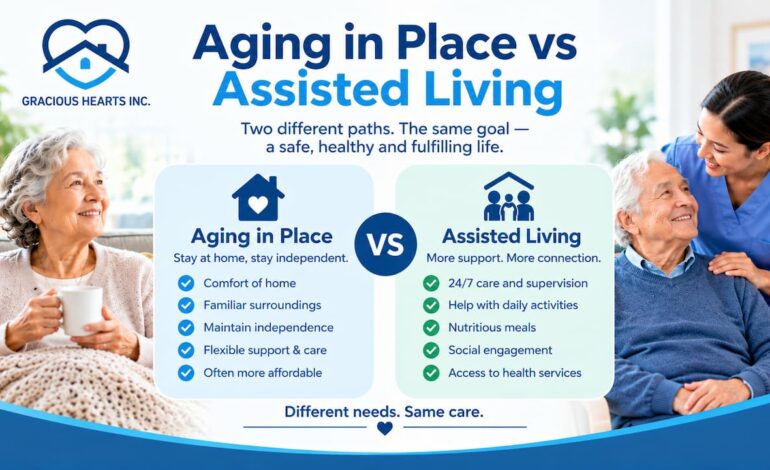
Aging in Place vs Assisted Living: Key Differences
At some point, almost every family asks the same question: stay at home, or move somewhere with more support?
Aging in place means staying in your own home, with help brought in as needed. Assisted living means moving into a community that bundles housing, meals, and daily care together in one place. Neither one is automatically better, it depends on health needs, budget, and how much support is already in place.
This guide walks through both options honestly, including real costs, so you can see what actually fits.
What Is Aging in Place?
Aging in place simply means staying in your own home as you get older, instead of moving to a facility.
It can look like a few safety upgrades and occasional help from family. Or it can mean a full care plan, with a paid caregiver coming in daily. The National Institute on Aging notes that aging in place takes real planning, since a home that worked fine at 60 doesn’t always work at 85 without changes.
What Is Assisted Living?
Assisted living is a residential community built around daily personal care.
Residents get their own apartment, plus help with things like bathing, dressing, and medication. Meals, housekeeping, and social activities are usually included too. It’s designed for people who need regular support but not full medical care.
Aging in Place vs Assisted Living: Pros and Cons
Both paths have real tradeoffs, and the right one depends on the person, not just the price tag.
Aging in place tends to offer:
- Comfort and familiarity of a known environment
- More control over daily routine
- Lower cost, if care needs stay light
- Closer connection to an existing neighborhood or community
Aging in place tends to struggle with:
- Home maintenance and safety upgrades
- Risk of isolation if visits aren’t consistent
- Costs that climb fast once daily care is needed
- More coordination falling on family members
Assisted living tends to offer:
- Built-in supervision and quicker help in an emergency
- Meals, housekeeping, and social activities all handled
- A ready-made community, less dependent on family scheduling
- One predictable monthly bill
Assisted living tends to struggle with:
- Smaller, shared living space
- Less day-to-day privacy and routine control
- A higher starting price point
- An adjustment period after leaving a longtime home
Real Cost Comparison
Cost is usually the first question families ask, and the honest answer is: it depends on how much care is actually needed.
Nationally, a non-medical home caregiver runs a median of $6,673 a month, according to the 2025 CareScout Cost of Care Survey. Assisted living communities run a median of $6,200 a month in the same survey. Those two numbers are closer than most people expect.
| Care Type | National Monthly Median | Source |
| Non-medical in-home care | $6,673 | CareScout 2025 |
| Assisted living community | $6,200 | CareScout 2025 |
Here’s the part that trips people up: that home care figure assumes a lot of hours. If someone only needs a few hours of help a day, aging in place is usually much cheaper. If they need near-constant supervision, the hourly costs can climb past what assisted living would charge.
In Arizona, assisted living typically runs between $3,500 and $8,000 a month, depending on the community and care level. That’s worth comparing directly against local in-home care rates before deciding.
Safety and Health Considerations
Safety is where this decision gets personal fast.
A home can be made much safer with grab bars, better lighting, and a few layout changes. But a fall or a medical emergency still depends on someone being there to notice. Assisted living solves that with staff on site around the clock, which matters more for someone with a history of falls or a progressing condition.
Social Connection and Isolation
Isolation is a real risk with aging in place, even in a safe, well-equipped home.
Without regular visitors or planned activities, days at home can blur together with very little interaction. Assisted living builds social contact into daily life, through shared meals and group activities, which some people genuinely thrive on and others find overwhelming.
They’re Not Always Either/Or
Here’s something most comparisons miss: this isn’t always a one-time, all-or-nothing choice.
In-home care often works as a middle step, filling the gap for years before anyone needs to think about a move. For some families it delays assisted living significantly, for others it turns out to be enough on its own.
In-home care services can flex up or down as needs change, which is part of why so many families start there first.
How to Decide
A few honest questions usually cut through the back-and-forth faster than any pros and cons list.
How many hours of help does the person actually need right now? Is there someone reliable checking in regularly, or is the home mostly quiet? Has there been a recent fall, missed medication, or a noticeable drop in how well daily tasks are getting done?
If the answers point to light, occasional support, staying at home with some extra help often makes sense. If the answers point to frequent supervision needs or real safety concerns, it’s worth taking a closer look at how much independence someone can safely manage alone.
Frequently Asked Questions
Is it cheaper to age in place or go to assisted living?
Cost comparisons between aging in place and assisted living depend almost entirely on how many care hours are needed. Light, occasional help usually keeps aging in place cheaper, while near-constant supervision can push in-home costs above what assisted living charges.
What are the risks of aging in place?
The risks of aging in place include fall hazards, missed medications, isolation, and slower emergency response if something goes wrong. Most of these risks can be reduced with home modifications and regular check-ins, but they don’t disappear entirely.
At what point should someone move to assisted living?
The point for moving to assisted living usually comes when daily care needs outpace what family or part-time help can reliably cover. Frequent falls, missed medications, or a caregiver reaching their own limit are common signals.
Can you age in place with dementia?
Aging in place with dementia is possible in the earlier stages, especially with structured routines and in-home support. As dementia progresses, the supervision and safety needs typically become difficult to manage without a community-based or memory care setting.
Does in-home care count as aging in place?
In-home care is generally considered part of aging in place, since the person stays in their own home while receiving outside help. It’s often the bridge that makes aging in place realistic for longer than it would be without support.
This decision rarely has one clean answer, and that’s normal. If your family is weighing both paths, Gracious Hearts Inc can help you think through what level of support actually fits right now, with room to adjust as things change.