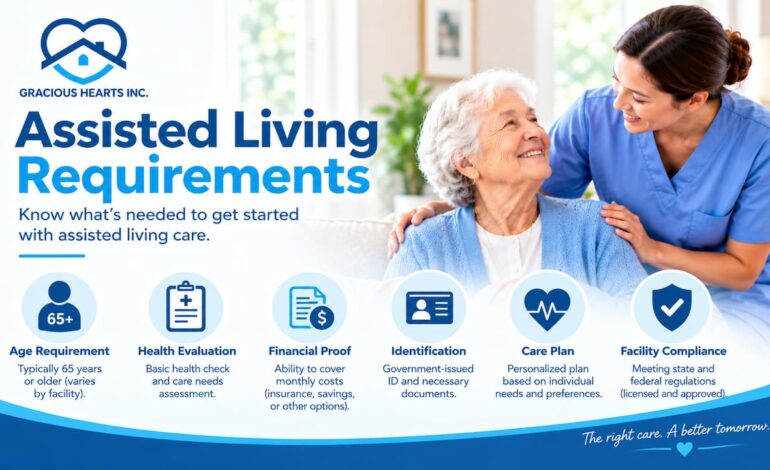
Assisted Living Requirements – The Complete Guide
Before touring a community, most families want to know one thing: will my parent actually qualify?
Assisted living requirements usually include needing help with daily activities, being able to live mostly independently, and not needing 24-hour skilled nursing care. Many communities also set a minimum age, often 55 to 60, and ask for a health assessment. The exact rules vary by state and by each community.
Here’s what that looks like in practice, including how Arizona handles it.
The Basic Requirements
Most communities look at the same handful of things when deciding if someone is a good fit.
Here’s the usual checklist:
- Needing help with some daily activities, such as bathing, dressing, or medications
- Being able to live semi-independently, with support nearby
- Not needing round-the-clock skilled nursing care
- Meeting the community’s minimum age
- Completing a health and care needs assessment
- Being able to pay, privately or through an approved program
No single national rule covers all of this. States license assisted living differently, and each community sets its own admission policy on top.
Needing Help With Daily Activities
Assisted living is built for people who need a hand, but not constant medical care.
Many communities look for help needed with at least two daily activities, often called ADLs. These include bathing, dressing, grooming, eating, moving around, and managing medications. A few communities are more flexible, and others are stricter.
If someone only needs a few hours of help a week, assisted living may be more than they need right now. In that case, in-home care services can cover the gap while they stay in their own home.
Age Requirements
Age rules are usually simple and vary by community.
Many assisted living communities accept residents starting somewhere between 55 and 62. Some accept younger adults with disabilities, depending on how they’re licensed.
If your parent is close to the cutoff, ask the community directly. Policies can differ even between two buildings run by the same company.
Health and Medical Limits
Assisted living offers support, not a hospital level of care.
Most communities are not set up to care for someone who is bedridden, needs a feeding tube, or has a serious infection or complex medical needs. Staff can remind or help with medications and watch for changes, but ongoing skilled nursing is a different level of care.
If your parent’s needs are heavier, it helps to understand how a personal care home compares to assisted living before you narrow your search.
Memory and Safety Requirements
Residents generally need to be able to ask for help and respond safely in an emergency.
For many people in the early stages of memory loss, assisted living works well with the right support. As dementia progresses, safety needs often grow, such as wandering or not recognizing danger.
At that point, a community with a dedicated memory program may be the better fit. This guide on choosing a memory care home explains what to look for.
The Assessment and Paperwork
Almost every community starts with an assessment before move-in.
A nurse or staff member usually meets with your parent, reviews their health history, and asks how they manage daily tasks. Expect to share a medication list and details about any doctors involved. Some communities also ask for a recent medical evaluation from your parent’s doctor.
The assessment decides the care level, and the care level often affects the monthly price. Answer honestly, even if it feels uncomfortable, because an accurate picture leads to the right support.
Arizona Levels of Care and Licensing
In Arizona, the Department of Health Services licenses assisted living, and it sorts care into three levels.
According to ADHS licensing materials, facilities are also split by size. An assisted living home has 10 residents or fewer, and an assisted living center has 11 or more.
| Care Level | What It Means |
| Supervisory care | General oversight, being available for emergencies, reminders, and knowing where the resident is |
| Personal care | Hands-on help with daily activities like bathing and dressing |
| Directed care | For residents who may not recognize danger, ask for help, or make care needs known |
A community can only care for residents at the levels it’s licensed for. That’s why it’s worth asking which level a community holds before you commit.
Financial Requirements
Most families pay for assisted living out of pocket, so cost is a real requirement.
In Arizona, assisted living typically runs between $3,500 and $8,000 a month, depending on the community and care level. Communities may ask for proof of income or assets before move-in.
Arizona’s Medicaid long-term care program, ALTCS, can help eligible residents in approved facilities. According to the official ALTCS page and AHCCCS guidance, the gross monthly income limit for an individual is $2,982, effective January 1, 2026. Medical needs must qualify too, and room and board is usually still paid separately.
Requirements Can Change Over Time
Qualifying isn’t a one-time gate at move-in.
Communities reassess residents as health changes. If someone’s needs grow beyond what the community is licensed or staffed to handle, they may be asked to move to a higher level of care. That can come as a shock to families who thought the decision was settled.
Before signing, ask for the admission and discharge criteria in writing. Ask what specifically triggers a move, how much notice you’d get, and what the options would be.
Questions to Ask About Requirements
A few direct questions can save you a lot of guesswork.
Before you commit, it helps to ask:
- What are your written admission and discharge criteria?
- Which Arizona care levels are you licensed to provide?
- How often are residents reassessed, and who decides?
- What happens to the price if care needs increase?
- What are the next steps if my parent’s needs outgrow your community?
Good communities answer these without hesitation. If the answers feel vague, treat that as useful information.
What About Couples?
Couples often wonder what happens when only one partner needs care.
Many communities let a couple share an apartment even if one partner needs more help than the other. Each person is usually assessed on their own, and care fees are often set per person. Ask how the community handles it if one partner’s needs grow faster than the other’s.
If Someone Doesn’t Qualify Yet
Not qualifying doesn’t mean there’s no good option.
Someone with light needs may do well at home with a few hours of help each week. Someone with heavier medical needs may need a different setting altogether. Reading up on caring for an elderly parent at home can help you decide what makes sense now, and what might be next.
Needs change, so it’s fine to revisit the question every few months.
Frequently Asked Questions
Who qualifies for assisted living?
Assisted living eligibility generally goes to seniors who need help with daily activities but not 24-hour skilled nursing. They should also be able to live semi-independently and meet the community’s age, health, and financial criteria.
What is the minimum age for assisted living?
The minimum age for assisted living is set by each community, and many start between 55 and 62. Some communities also accept younger adults with disabilities, depending on their license and policies.
Can someone with dementia live in assisted living?
Dementia and assisted living can work together in the early to middle stages, with the right level of care. When safety risks like wandering grow, a community licensed for directed care or memory care is often a better fit.
Can assisted living deny admission?
Assisted living admission can be denied when a person’s needs are beyond what the community is licensed or staffed to provide. It can also be denied for financial reasons or if the assessment shows a different level of care is needed.
Does Arizona license assisted living facilities?
Arizona assisted living facilities are licensed by the Arizona Department of Health Services. They are licensed at the supervisory, personal, or directed care level, and a community can only serve residents within the levels it holds.
Every family’s situation is a little different, and requirements can feel like a lot to sort through. If you’d like to talk through what level of support fits your loved one in Arizona, Gracious Hearts Inc is happy to help you think it through.