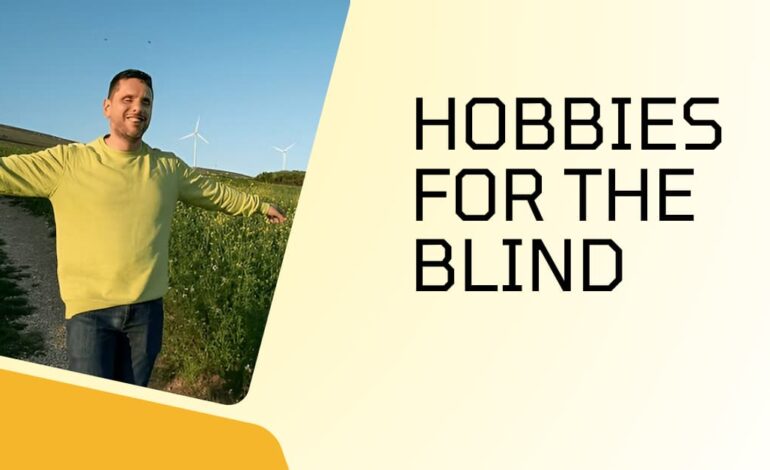
Hobbies for the Blind: Activities That Actually Work for Blind and Low-Vision Adults
Blindness does not take away curiosity, creativity, or the need to do something that feels meaningful. What it changes is how you get there.
Whether you are blind yourself, supporting a loved one with vision loss, or working in a care setting, this guide covers hobbies and activities that genuinely work without sight. Not vague suggestions, but specific activities organized by type, with the adaptive tools and community resources that make each one accessible.
A quick note on language before we start: this article uses the terms “blind” and “low vision,” which are the terms most widely preferred in the blind community. Some people prefer identity-first language (“blind person”). Others prefer person-first (“person with blindness”). Both are used here, as they are throughout the blind community itself.
Why Hobbies Matter More Than People Realize
There is a tendency, especially among family members and care providers, to think of activities for blind people as a nice extra. Something to fill time.
The research says otherwise.
Staying active and engaged directly supports mental health, cognitive function, physical health, and social connection. For blind and low-vision seniors in particular, meaningful activity reduces the risk of depression, slows cognitive decline, and counters social isolation, which the CDC has identified as a serious health risk comparable to smoking in terms of its impact on longevity.
The goal is not to keep someone busy. It is to help them feel capable, connected, and engaged with their own life.
Sensory Hobbies: Touch, Smell, and Taste
Pottery and Clay Work
Pottery is one of the most naturally accessible hobbies for blind people. Wheel throwing, hand-building, and sculpting all happen through touch. You feel the clay respond. You shape it with your hands. The finished piece can be touched and appreciated the same way it was made.
Many community pottery studios welcome blind and low-vision students, and a good instructor will narrate shapes verbally while the student feels the form develop. No sight required at any stage.
Gardening
Gardening is one of the most consistently recommended hobbies across every source of guidance for blind and low-vision adults, and for good reason.
Raised garden beds make the space navigable without needing to see where things are. Fragrant and textured plants like lavender, rosemary, mint, lamb’s ear, and sage create a sensory environment that is rich even without any visual element. The experience of planting something, watering it, and eventually harvesting or smelling it offers the same satisfaction for a blind gardener as it does for a sighted one.
Container gardens are a good starting point, particularly for older adults with limited mobility. A few pots of herbs on a patio can become a genuinely absorbing hobby.
Cooking and Baking
Cooking is one of those activities that many blind people give up unnecessarily because of safety concerns, real and assumed.
With a few adaptations, it remains accessible. Talking kitchen scales and measuring cups read out quantities clearly. Tactile markers can label dials and switches on appliances. Consistent kitchen organization, everything in a known place, reduces the need for visual searching. Many experienced blind cooks describe the sensory experience of cooking as richer once sight is removed, because smell, taste, and texture move to the foreground.
For seniors in care settings, supervised cooking and baking can be a meaningful activity that connects to lifelong skills and memories.
Knitting, Crocheting, and Tactile Crafts
Knitting and crocheting are learned and practiced entirely by touch. Once the movements are familiar, many blind and low-vision knitters report being able to work on complex patterns without any visual reference at all.
Other tactile crafts worth exploring include weaving, macrame, collage using textured materials, woodworking (with appropriate safety guidance), and clay modeling. These activities produce something tangible, which provides a sense of accomplishment that matters.
Audio Hobbies: Listening and Learning
Audiobooks and Talking Books
The National Library Service for the Blind and Print Disabled (NLS), operated by the Library of Congress, offers a completely free talking book program for eligible Americans. It sends out a special player along with audio recordings from a catalog of hundreds of thousands of titles. Enrollment is free and no internet connection is required.
For those who prefer digital, Audible, Libby (through public libraries), and Bookshare all offer extensive accessible libraries. Bookshare in particular offers a massive collection in audio and refreshable braille formats for people with qualifying disabilities.
Audiobooks are not a consolation prize for people who cannot read print. For many blind adults, listening to books has become a deeply satisfying primary form of engagement with literature.
Podcasts and Radio
Podcasts cover every topic imaginable, history, science, true crime, cooking, storytelling, philosophy, sports. For someone with vision loss who wants to stay intellectually engaged with the world, a well-chosen podcast library can be genuinely absorbing.
Traditional radio, including NPR programming and BBC World Service, also remains a rich source of news, drama, and documentary content that requires nothing except a working radio or smart speaker.
Music: Listening, Playing, and Singing
Music is one of the most universally accessible hobbies that exists, and it goes beyond passive listening.
Many blind adults learn to play instruments, and some of the most celebrated musicians in history, including Stevie Wonder, Ray Charles, Andrea Bocelli, and Jose Feliciano, were blind. Learning an instrument as an adult is entirely possible, and Hadley Institute for the Blind and Visually Impaired offers free distance learning courses in music theory and instrument instruction.
Choir, community singing groups, and drumming circles are also worth exploring for anyone who prefers a social musical outlet over solo practice.
Learning Something New
Hadley Institute for the Blind and Visually Impaired offers a wide range of free courses for blind and low-vision adults, covering everything from technology to cooking to crafts to personal finance. These are distance learning courses designed specifically for accessibility, available by phone, online, or in accessible formats.
Learning something new, a language, an instrument, a craft technique, is one of the most effective ways to stay mentally active and engaged regardless of vision status.
Physical Hobbies and Adaptive Sports
Walking and Hiking
Walking is one of the most accessible physical activities for blind and low-vision adults. With a white cane, a guide dog, a sighted guide, or a GPS-based navigation app, many blind people walk independently in familiar environments and with support in new ones.
Hiking on accessible trails is also genuinely possible. Several U.S. national and state parks have developed tactile trails with rope guides, audio stations, and textured signage. Choosing paved or well-maintained paths and going with a familiar companion makes this reliably doable.
Tandem Cycling
Tandem bikes, where two riders share a bicycle with separate pedals, allow a blind rider to enjoy the physical experience of cycling without needing to navigate independently. The sighted rider sits at the front and steers. The blind rider in the rear contributes full pedaling effort.
Tandem cycling has an established adaptive sports community and is featured in the Paralympics. Many cities have tandem cycling clubs that welcome blind and low-vision participants.
Goalball
Goalball is a team sport created specifically for blind and visually impaired athletes. It is played on a basketball-sized court with a ball that has bells inside. All players, including those with some remaining vision, wear eyeshades to equalize competition. Players use their hearing to locate the ball and try to roll it into the opposing team’s goal.
It is a Paralympic sport with national and regional leagues across the United States. For anyone interested in competitive sport, it is worth looking up whether a league exists nearby.
Swimming
Swimming is one of the most naturally accessible sports for blind people. Lanes are clearly defined. Coaches guide using verbal instruction and touch. Water itself provides immediate sensory feedback about position and movement.
Many blind adults swim recreationally and competitively. The U.S. Association of Blind Athletes (USABA) organizes competitive swimming programs and can connect interested individuals with local clubs.
Yoga, Tai Chi, and Seated Exercise
Chair yoga and seated tai chi are widely available through verbal instruction, which means they translate fully to blind and low-vision participants. Hadley and many senior centers offer free programs in these formats.
For older or less mobile adults, seated exercise programs provide meaningful physical activity without requiring any visual component.
Games and Social Activities
Accessible Board Games and Card Games
Many classic games have accessible versions. Braille Scrabble, braille chess, braille playing cards, and tactile dominoes are all commercially available. The American Printing House for the Blind (APH) produces a range of adapted games specifically for blind and low-vision players.
Large-print playing cards are helpful for low-vision adults who retain some sight. Verbal word games, trivia, and memory challenges work entirely through listening and speaking.
Verbal Word Games and Trivia
Trivia nights, storytelling groups, verbal crossword puzzles, and word association games require no visual component and are genuinely engaging. The crossword format works well when clues are read aloud and answers are worked through verbally with a companion or group.
Storytelling and Oral History
Sharing and recording life stories is an activity that carries real emotional and social weight, particularly for older adults. It does not require sight at any stage.
Many organizations collect oral histories from older adults and help turn them into recorded memoirs or written collections. Story circles, where a small group shares and responds to personal narratives, combine social connection with meaningful creative expression.
Volunteering
Many volunteer roles work well for blind and low-vision participants. Phone-based volunteer work, including crisis helplines, peer support programs, and telephone befriending services for other isolated seniors, requires no sight at all.
IBVI (Industries for the Blind and Visually Impaired) and similar organizations provide pathways into meaningful community involvement for blind adults of all ages.
Adaptive Technology That Opens Up More Hobbies
A few tools worth knowing about:
- Screen readers. Software like JAWS (Job Access With Speech) and NVDA reads on-screen content aloud, allowing blind users to access the internet, email, social media, and most apps independently.
- Refreshable braille displays. These convert digital text into tactile braille, allowing a blind reader to read on-screen content through touch.
- Talking devices. Talking kitchen scales, talking clocks, talking blood pressure monitors, and talking caller ID devices all exist and are widely available.
- Smart speakers. Amazon Echo and Google Nest devices allow voice-controlled access to music, audiobooks, podcasts, timers, weather, news, and general knowledge questions without requiring any visual interface.
- Be My Eyes. A free app that connects blind users with sighted volunteers via a live video call to help with tasks that benefit from visual input, reading a label, checking an expiration date, describing a scene.
- Accessible GPS navigation apps. Seeing AI (Microsoft) and Google Maps with accessibility features both provide audio navigation support.
These tools do not replace hobbies but they expand what is accessible and how independently a blind person can pursue them.
Hobbies for Blind Seniors Specifically
Older adults who develop vision loss later in life face a specific challenge: they are relearning how to do things they have done for decades. The adjustment is emotional as well as practical.
A few things that help in care and family settings:
- Connect new activities to old ones. A woman who loved cooking can still cook with adapted tools. A man who loved gardening can still garden with raised beds. Preserving continuity with past identity matters enormously for mood and self-worth.
- Start smaller. Activities that once required long sessions can be adapted to shorter, lower-intensity versions. A half hour of pottery. A chapter of an audiobook. A short walk in a familiar space.
- Focus on what remains, not what is lost. Blindness removes one sense. Touch, hearing, smell, taste, movement, memory, and social connection remain. The best hobbies for blind seniors lean into those remaining capacities rather than working around an absence.
- Choose activities with social built in. Isolation is one of the most serious health risks for older adults with vision loss. Activities that involve other people, whether a knitting group, a singing group, a trivia night, or a gardening club, serve a dual purpose.
In a care home setting, daily activities for blind or low-vision residents should include sensory stimulation (scent-based activities, textured objects, music), cognitive engagement (trivia, storytelling, word games), physical movement (chair yoga, short walks), and meaningful social contact. These are not extras. They are part of quality care.
At Gift of Love, operated by Gracious Hearts Inc. in Phoenix, activities and daily engagement are built around each resident’s individual interests, abilities, and background. For residents with vision loss, that means finding the hobbies and routines that still work, and making sure they happen. If you are exploring care options for a loved one with blindness or low vision and want to understand how daily life and activities are structured, reach out to Gracious Hearts Inc. or explore the Gift of Love page to learn more.
Resources Worth Bookmarking
- National Library Service for the Blind and Print Disabled (NLS): loc.gov/nls — free talking books and braille, no internet required
- Hadley Institute for the Blind and Visually Impaired: hadley.edu — free distance learning courses on dozens of topics
- American Printing House for the Blind (APH): aph.org — adapted games, educational materials, and assistive tools
- US Association of Blind Athletes (USABA): usaba.org — adaptive sport programs and competitive opportunities
- Be My Eyes: bemyeyes.com — free app connecting blind users with sighted volunteers
- American Foundation for the Blind (AFB): afb.org — information hub covering adaptive technology, employment, education, and daily living
One Thing to Remember
Blindness changes how you do things, not whether you do them.
Pottery, music, gardening, cooking, cycling, swimming, storytelling, trivia, and dozens of other activities are genuinely accessible to blind and low-vision people with the right tools, support, and adaptive approach. The most important starting point is not a list of activities. It is a conversation about what the person already cares about and what version of that still works.
Start there, and the rest tends to follow.