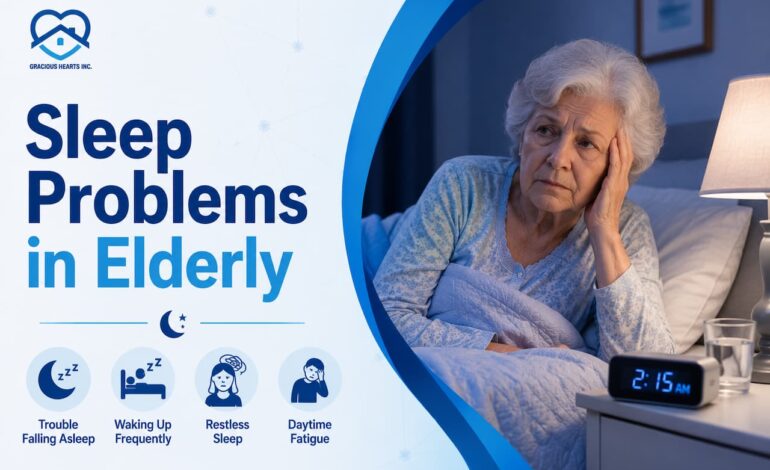
Sleep Problems in Elderly Adults: What Changes, What Goes Wrong, and What Actually Helps
Poor sleep is common in older adults. But common does not mean inevitable, and it does not mean untreatable.
Up to 50 percent of older adults report some form of sleep problem, according to the National Council on Aging. Yet waking up tired is not a normal or acceptable part of healthy aging. The distinction between normal sleep changes that come with age and actual sleep disorders that need attention is one most families and even many clinicians miss, and getting it right is the starting point for actually improving sleep.
If you are caring for an elderly parent who sleeps poorly, wakes repeatedly at night, cannot fall asleep, sleeps at unusual hours, or seems exhausted no matter how long they rest, this guide explains what is happening and what can realistically be done about it.
At Gift of Love, operated by Gracious Hearts Inc. in Phoenix, daily routines, lighting, activity, and social engagement are structured in ways that support better sleep quality for residents. More on how the care environment matters later in this guide.
How Sleep Normally Changes With Age
Before getting into disorders and solutions, understanding what normal age-related sleep changes look like prevents unnecessary alarm and helps identify what is beyond normal.
The brain’s internal clock, called the suprachiasmatic nucleus (SCN), sits in the hypothalamus and controls the body’s 24-hour circadian rhythm. With age, the SCN weakens. It produces less melatonin, the hormone that signals the body to prepare for sleep, and responds less strongly to light and darkness as time cues.
The result is a predictable set of changes:
Circadian shift. The sleep-wake cycle shifts earlier. An older adult who once felt sleepy at 11 pm may now feel genuinely tired at 7 or 8 pm and wake spontaneously at 3 or 4 am. This is called advanced sleep-wake phase, and it is a normal consequence of SCN aging, not insomnia.
Less deep sleep. The percentage of time spent in slow-wave NREM (deep, restorative sleep) decreases with age. Older adults spend more time in lighter sleep stages, making them more easily disturbed by noise, light, or movement.
More nighttime waking. Lighter sleep means more frequent brief awakenings. Some degree of nighttime waking is normal in older adults and does not require intervention if the person falls back asleep reasonably quickly and feels rested during the day.
Shorter total sleep time. Many older adults naturally sleep six to seven hours rather than the seven to nine hours recommended for adults generally. The question is whether they feel rested, not whether they hit a specific hour count.
What is not normal, and what warrants investigation: difficulty falling asleep most nights, lying awake for long stretches, waking unrefreshed consistently, significant daytime sleepiness that impairs function, or behavioral changes during sleep.
The Main Sleep Disorders in Elderly Adults
Insomnia
Insomnia in older adults is defined as persistent difficulty falling asleep, staying asleep, or waking too early, with daytime consequences. It is the most common sleep disorder in this age group.
Contributing factors specific to elderly adults include chronic pain, depression, anxiety, medication side effects, and the loss of routine that can follow retirement, bereavement, or a move to a new environment. A cross-sectional study published in November 2025 in ScienceDirect specifically examined insomnia risk in older adults living alone and found social isolation, depression, and loss of structured daytime activity as the strongest predictors.
Insomnia matters beyond quality of life. A comprehensive 2025 meta-analysis published in GeroScience, incorporating 39 cohort studies, found that insomnia was associated with a 36 percent increased risk of all-cause dementia (hazard ratio 1.36) and a 49 percent increased risk of Alzheimer’s disease specifically (HR 1.49). A parallel systematic review in the Journal of Neurology, also published in 2025, confirmed the association across 76 cohort studies.
The proposed mechanism: during sleep, the brain’s glymphatic system flushes out metabolic waste including beta-amyloid and tau proteins, the molecules associated with Alzheimer’s pathology. Disrupted sleep reduces glymphatic clearance, allowing these proteins to accumulate. Research from NIA and Johns Hopkins found that older adults with poor sleep quality had measurably higher beta-amyloid burden in the brain than those without sleep problems.
Obstructive Sleep Apnea
Obstructive sleep apnea (OSA) occurs when the upper airway repeatedly collapses during sleep, causing brief stops in breathing followed by partial arousal. It affects an estimated 20 to 60 percent of adults over 65, making it the most prevalent sleep disorder in this age group by some measures, yet it is dramatically underdiagnosed because many elderly adults do not have a bed partner to notice the snoring and gasping that typically prompt testing.
In older adults, OSA may present less typically. Instead of snoring and witnessed apneas, the primary complaints may be excessive daytime sleepiness, morning headaches, frequent nighttime urination, or cognitive fog. These are easy to attribute to other causes, which is why OSA goes undetected for years in many older adults.
The cognitive stakes are significant. The same 2025 GeroScience meta-analysis found OSA associated with a 33 percent increased risk of all-cause dementia (HR 1.33) and a 45 percent increased risk of Alzheimer’s disease (HR 1.45). More encouragingly, a study published in December 2025 by researchers at Johns Hopkins, the University of Florida, and the University of Maryland found that CPAP treatment for OSA was associated with slowed cognitive decline over a 10-year follow-up period in older adults with the condition.
CPAP, the continuous positive airway pressure device worn during sleep to keep the airway open, is the primary treatment for OSA. Adherence is the challenge, particularly in older adults who find the mask uncomfortable. Newer CPAP devices are quieter and more comfortable than older generations, and a sleep specialist can often identify a mask style and settings that improve compliance.
Restless Legs Syndrome
Restless legs syndrome (RLS) is characterized by an overwhelming urge to move the legs, usually in the evening or at night, accompanied by uncomfortable crawling, tingling, or burning sensations. It disrupts sleep onset and can cause significant distress.
RLS is more common in older adults and can be exacerbated by iron deficiency, kidney disease, diabetes, and certain medications including antidepressants and antihistamines. It is also associated with periodic limb movement disorder (PLMD), where the legs jerk involuntarily during sleep, further fragmenting rest.
Treatment depends on severity. Mild RLS often responds to lifestyle measures: stretching, warm baths, reducing caffeine and alcohol, and correcting iron deficiency if present. More severe cases may warrant medication under specialist guidance.
REM Sleep Behavior Disorder
REM sleep behavior disorder (RBD) involves acting out vivid, often violent dreams during REM sleep. The normal muscle paralysis that occurs during REM sleep fails, and the person may shout, kick, punch, or fall out of bed while dreaming. It can be dangerous for both the person and anyone sleeping nearby.
RBD warrants serious clinical attention beyond its immediate sleep disruption because it is now recognized as a strong early marker of neurodegenerative disease. Research confirms that a significant proportion of people diagnosed with RBD, some estimates exceed 80 percent, will eventually develop Parkinson’s disease, Lewy body dementia, or multiple system atrophy, often years or decades before other symptoms appear.
If an older adult is acting out dreams during sleep, this warrants a prompt conversation with a neurologist, not just a sleep specialist.
The Loneliness and Isolation Connection
One angle that rarely appears in guides on elderly sleep problems: social isolation and loneliness are direct contributors to poor sleep quality.
A 2026 study published in Psychiatry International specifically examined psychological mechanisms of sleep disorders in elderly adults living in nursing homes. It found that loneliness increased sleep problems through anxiety and depression as mediating pathways. The more isolated a resident felt, the worse their sleep quality, and anxiety and depression were the mechanisms through which loneliness exerted that effect.
This matters practically. Interventions that reduce loneliness, increase social contact, and promote structured daily activity and meaningful relationships with consistent caregivers may improve sleep quality through psychological pathways that no medication addresses. It also means that a care environment characterized by social connection and routine is not a peripheral factor in sleep health. It is a central one.
Health Consequences of Poor Sleep in Elderly Adults
Beyond the dementia risk, chronic poor sleep in older adults is associated with a meaningful cluster of health consequences:
Falls and injury. Sleep deprivation impairs balance, reaction time, and judgment, all of which contribute to fall risk. Given that falls are the leading cause of injury-related death in adults over 65, this is not a minor concern.
Cardiovascular disease. Poor sleep quality has been associated with higher rates of hypertension, heart disease, and stroke. A 2026 study published in Circulation specifically linked sleep disorders to coronary artery disease severity in older adults.
Depression and anxiety. The relationship between poor sleep and mood disorders is bidirectional: each worsens the other. Treating sleep often improves mood, and treating depression often improves sleep.
Immune function. Sleep is essential for immune regulation. Chronically poor sleep weakens immune response and slows recovery from illness.
Physical function and quality of life. Fatigue from poor sleep limits activity, which reduces strength and mobility over time, contributing to functional decline.
What Actually Helps: Evidence-Based Solutions
Cognitive Behavioral Therapy for Insomnia (CBT-I)
CBT-I is the first-line treatment for chronic insomnia in older adults, recommended over sleep medications by the American Academy of Sleep Medicine, the National Institutes of Health, and virtually every relevant clinical guideline.
CBT-I is a structured program, typically six to eight sessions with a trained therapist, that addresses the thoughts, behaviors, and habits that perpetuate insomnia. It includes techniques such as sleep restriction therapy, stimulus control, sleep hygiene education, and cognitive restructuring of unhelpful beliefs about sleep.
A 2026 meta-analysis published in BMC Nursing confirmed that nurse-led CBT-I significantly improved insomnia outcomes in adults, consistent with decades of prior evidence. In elderly adults specifically, CBT-I produces comparable improvements to medication without the risks that make sleeping pills particularly problematic in this population.
CBT-I can be delivered in person with a therapist, in a group setting, or through digital platforms (dCBT-I), which expands access for elderly adults who have difficulty traveling.
Sleep Hygiene That Is Actually Relevant for Older Adults
Standard sleep hygiene advice is usually written for 35-year-olds. For elderly adults, the relevant points are:
Light exposure. Morning bright light exposure helps anchor the circadian rhythm. For someone with an advanced sleep phase (falling asleep at 7pm, waking at 3am), evening light exposure may help delay the sleep cycle. A simple lightbox or outdoor time in the late afternoon can make a genuine difference.
Consistent wake time. Keeping the same wake time every day, including weekends, is the single most effective behavioral anchor for sleep timing. Sleeping in after a bad night actually makes the next night worse by reducing sleep pressure.
Daytime activity. Physical activity during the day, even light walking, improves sleep quality that night. Sedentary days reliably produce worse sleep.
Temperature. The bedroom should be cool, around 65 to 68 degrees Fahrenheit. Core body temperature drops during sleep and a warm environment interferes with that process.
Limiting time in bed awake. Lying in bed unable to sleep trains the brain to associate the bed with wakefulness. Getting up and doing something calm until sleepiness returns, rather than lying awake for hours, is a core CBT-I principle.
Alcohol. Alcohol may help someone fall asleep initially but consistently disrupts sleep architecture in the second half of the night, reducing REM sleep and increasing nighttime waking.
Medication: When It Is Appropriate and When It Is Not
Sleep medications are generally not recommended as a first-line or long-term approach for elderly adults, for clear clinical reasons.
The American Geriatrics Society Beers Criteria, updated regularly and used widely in geriatric prescribing, lists benzodiazepines (such as lorazepam and temazepam) and Z-drugs (such as zolpidem and eszopiclone) as potentially inappropriate medications for older adults. Risks specific to this population include next-day sedation, increased fall and fracture risk, cognitive impairment, and dependence.
Melatonin is generally considered safer for elderly adults and can be useful for circadian rhythm issues, particularly in low doses (0.5 to 1mg) taken in the early evening. However, it is more effective for phase adjustment than for sleep maintenance insomnia.
If medication is being considered, the conversation belongs with a geriatrician or physician familiar with the Beers Criteria, not a general practitioner who may not be aware of age-specific risks.
When to See a Doctor
A physician visit is warranted when:
- Sleep problems have persisted for more than three months and are affecting daytime function
- There are signs of sleep apnea: loud snoring, witnessed breathing pauses, morning headaches, or unexplained daytime sleepiness
- An older adult is acting out dreams physically during sleep (possible RBD)
- Sleep problems coincide with mood changes, new medication, or a recent health event
- An over-the-counter sleep aid is being used regularly
How the Care Environment Affects Sleep
One thing consistently missing from guides on elderly sleep problems: the care setting itself is a sleep variable.
Noise, inconsistent routines, unfamiliar environments, inadequate natural light, lack of daytime activity, and social isolation all independently disrupt sleep in older adults. In a large institutional care setting, many of these factors are difficult to control. Shift changes happen at night. Other residents make noise. Lighting is often artificial and poorly timed. Routines are set by institutional scheduling rather than individual biology.
In a small residential care home, many of these factors are easier to manage. The environment is quieter. Routines can be adapted to individual sleep patterns. Natural light and outdoor time are more accessible. Consistent caregivers who know each resident’s habits can notice and respond to sleep changes early, before they become chronic problems.
A 2026 study in Psychiatry International found that in elderly nursing home residents, social connection and meaningful relationships mediated the effect of loneliness on sleep quality. Small homes where residents feel genuinely known and connected show meaningfully better wellbeing outcomes across multiple dimensions, sleep included.
At Gift of Love in Phoenix, the small-home model, consistent staff, structured daily activity, and genuine social engagement are part of how care is delivered every day. If sleep quality and daily wellbeing are factors in your care decision, it is worth understanding how the environment shapes those outcomes.
You can learn more on the Gift of Love page or explore how Gracious Hearts approaches care for each resident individually. For questions specific to your situation, call (480) 705-9118.
A Quick Reference: Sleep Problems in Elderly Adults
Common age-related changes (normal):
- Earlier sleep and wake times
- More frequent brief nighttime waking
- Less deep sleep, more light sleep
- Slightly shorter total sleep time
Sleep disorders requiring attention:
- Insomnia: persistent difficulty falling or staying asleep with daytime consequences
- Obstructive sleep apnea: breathing interruptions during sleep, often with daytime sleepiness
- Restless legs syndrome: uncomfortable urge to move legs at night
- REM sleep behavior disorder: physically acting out dreams (warrants neurology referral)
First-line treatment: CBT-I, not medication
Red flags warranting prompt medical evaluation:
- Acting out dreams physically
- Witnessed breathing pauses during sleep
- Sudden significant change in sleep pattern
- Excessive daytime sleepiness interfering with safety or function
Related Reading on the Gracious Hearts Blog: