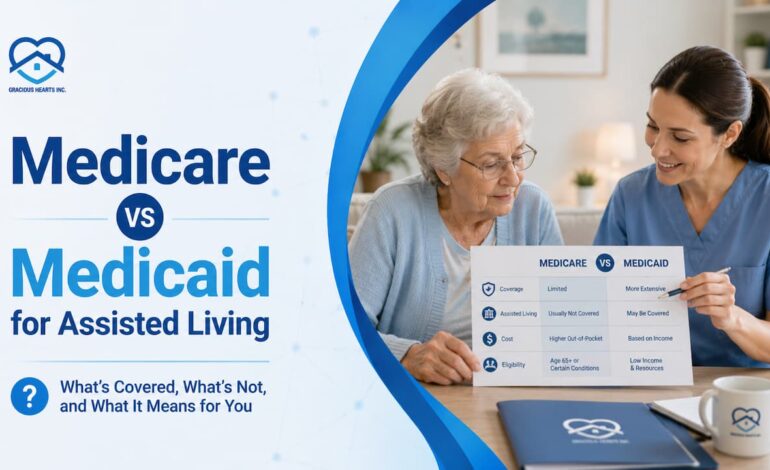
Medicare vs Medicaid for Assisted Living: What Each Program Actually Covers
The confusion between Medicare and Medicaid is understandable. Both are government health programs. Both serve elderly adults. And both have names that sound similar enough to be genuinely confusing.
But when it comes to assisted living costs, they function very differently. Medicare almost never covers assisted living. Medicaid may cover care services in assisted living, but not the room and board. And in Arizona, a program called ALTCS makes Medicaid assistance available in a way that is meaningfully different from most other states.
This guide explains both programs clearly, what each covers and what it does not, with specific detail on how Arizona families can access Medicaid help for assisted living costs.
If your family is currently trying to figure out how to fund a parent’s care at a place like Gift of Love, operated by Gracious Hearts Inc. in Phoenix, this breakdown will help you understand which programs to explore and what to ask an elder law attorney before making decisions.
The Core Difference: What Each Program Is
Before getting into assisted living specifics, the structural difference matters.
Medicare is a federal health insurance program for adults 65 and older and certain younger people with disabilities. It is not means-tested. You qualify based on age and work history, not income or assets. Medicare is designed to cover acute medical care: hospitalizations, doctor visits, prescription drugs, and short-term skilled rehabilitation. It is not designed to cover long-term care.
Medicaid is a joint federal and state program that provides health coverage and long-term care services to people with limited income and assets. It is means-tested. Eligibility is based on financial need plus, for long-term care specifically, a medical determination that the person needs a certain level of care. Medicaid is the primary public payer for long-term care in the United States.
That distinction is the foundation of everything else.
What Medicare Covers in Assisted Living: Essentially Nothing
Medicare does not cover assisted living room and board. It does not cover ongoing personal care assistance with bathing, dressing, or medication management. It does not cover long-term custodial care of any kind, whether delivered in an assisted living facility or anywhere else.
This surprises many families who assumed Medicare, having covered so much throughout a parent’s working life, would continue to cover care in their final years. It does not. The GAO confirmed in a June 2026 report that Medicare’s coverage in assisted living settings is limited to specific clinical services that would be covered regardless of where the beneficiary lives.
What Medicare does cover inside an assisted living facility:
Doctor and specialist visits under Part B, billed the same way as if the resident lived at home.
Prescription drugs through a Part D plan.
Hospice care under Part A, for residents who qualify based on a terminal diagnosis with a life expectancy of six months or less.
Short-term home health services for residents assessed as homebound and needing intermittent skilled nursing or therapy, ordered by a physician.
What Medicare does not cover: the assisted living facility’s monthly fee, room and board, personal care assistance, or any ongoing custodial services.
The Skilled Nursing Facility Exception
There is one situation where Medicare does pay for care in a facility: short-term stays in a skilled nursing facility (SNF) following a qualifying hospital inpatient stay.
Under Medicare Part A in 2026, coverage works as follows:
- Days 1 to 20: Medicare covers 100 percent of approved costs
- Days 21 to 100: The resident pays $217 per day in coinsurance; Medicare covers the rest
- Day 101 and beyond: Medicare pays nothing; full cost falls to the resident or another payer
This is not assisted living coverage. It is short-term rehabilitation coverage in a licensed skilled nursing facility, specifically for people recovering from a hospitalization. It ends when the patient stops making measurable clinical progress. It is a different setting than assisted living and a temporary benefit, not long-term support.
Medicare Advantage: A Limited Expansion
Medicare Advantage plans (Part C) have expanded supplemental benefits in recent years and some now include limited in-home personal care, meal delivery, or transportation assistance. As of 2026, none of these plans cover assisted living room and board. The supplemental benefits vary by plan and are generally modest amounts toward non-medical support services. They can help at the margins but do not change the fundamental answer: Medicare does not pay for assisted living.
What Medicaid Covers in Assisted Living: Care, Not Room and Board
Medicaid’s relationship with assisted living is more nuanced, and more useful, than Medicare’s.
A June 2026 GAO report found that 44 states cover assisted living services through Medicaid, with 29 of those states doing so through Home and Community-Based Services (HCBS) waivers. Federal Medicaid spending for services provided in assisted living settings totaled at least $3.5 billion in 2024.
Here is the critical distinction: Medicaid can pay for care services delivered inside an assisted living facility. Federal law does not permit Medicaid to pay for room and board in an assisted living setting.
In practical terms, this means:
- Medicaid may cover: personal care assistance, medication management, nursing oversight, case management, and similar care services
- Medicaid does not cover: rent, meals, housekeeping, or the facility’s base monthly fee
The family remains responsible for room and board even when Medicaid is covering the care component. In many assisted living settings, the room and board portion represents the majority of the monthly bill.
This gap is something families frequently misunderstand until they are in the middle of the application process. It is worth understanding clearly before making any placement decisions.
Arizona’s ALTCS: The Most Important Thing Arizona Families Need to Know
In Arizona, Medicaid long-term care services are delivered through the Arizona Long Term Care System, known as ALTCS. ALTCS is administered through Arizona’s Medicaid program, AHCCCS (Arizona Health Care Cost Containment System).
ALTCS covers long-term care in nursing homes, assisted living facilities, adult foster care homes, and home and community-based settings for eligible Arizona residents.
The single most important thing to understand about ALTCS: it has no waitlist.
Most states deliver Medicaid HCBS services through waiver programs that cap enrollment. When the cap is full, applicants wait, sometimes for years. Arizona does not operate this way. ALTCS is structured as an entitlement: any person who meets both the financial and medical eligibility requirements is enrolled immediately and begins receiving services. There is no queue.
For Arizona families, this means Medicaid assistance is accessible in a timeframe that is simply not available in most other states.
ALTCS Financial Eligibility in 2026
For a single applicant:
- Income limit: $2,982 per month (300% of the Federal Benefit Rate, updated January 2026)
- Asset limit: $2,000 in countable assets
- Home equity exemption: the primary home is not counted as an asset up to $752,000 in equity (2026)
- One vehicle is also exempt
For a married couple (one spouse applying):
- Income limit: $2,982/month for the applicant; the non-applicant spouse’s income is not counted
- Asset limit: $2,000 for the applicant spouse; the community spouse may retain up to $162,660 (the Community Spouse Resource Allowance, or CSRA)
Countable assets include bank accounts, retirement accounts, stocks, bonds, and certificates of deposit. Non-countable assets include the primary home, one vehicle, personal property, and certain irrevocable burial accounts.
What if income exceeds the limit?
An applicant whose monthly income exceeds $2,982 is not automatically disqualified. Arizona allows the use of a Miller Trust, also called a Qualified Income Trust, to redirect excess income into a trust that satisfies the income cap requirement. This is a legal planning tool, not a loophole, and it must be set up properly with legal guidance.
Important: ALTCS has a look-back provision. Applicants may not give away assets to become eligible. Asset transfers made within the look-back period are scrutinized and can affect eligibility.
ALTCS Medical Eligibility
Financial eligibility is only half the picture. ALTCS also requires a medical determination.
Applicants must pass a Pre-Admission Screening (PAS) conducted by ALTCS staff. The screening assesses whether the applicant needs a Nursing Facility Level of Care (NFLOC), meaning the kind of full-time assistance normally associated with a nursing home. This level of care is defined by functional limitations in Activities of Daily Living (ADLs) such as bathing, dressing, eating, and mobility, along with cognitive and medical factors.
Meeting financial limits but not the medical threshold means the applicant does not qualify for ALTCS long-term care services. Meeting both means immediate enrollment.
What ALTCS Does and Does Not Cover in Assisted Living
ALTCS covers care services in licensed assisted living facilities, including personal care, medication management, nursing oversight, and case management for eligible members.
ALTCS does not cover room and board in assisted living. The resident or family is responsible for the room and board portion of the facility’s monthly cost, even when ALTCS covers all the care services.
For families considering a small residential care home like Gift of Love in Phoenix, it is worth asking the facility directly whether they accept ALTCS-covered residents and how the room and board cost is structured separately from care costs. You can reach the Gracious Hearts Inc. team at (480) 705-9118 or through the contact page to discuss how ALTCS works in their setting.
Quick Comparison: Medicare vs Medicaid for Assisted Living
Medicare:
- What it is: Federal health insurance for adults 65+
- Who qualifies: Based on age and work history, not income
- Covers AL room and board: No
- Covers AL care services: No (covers medical services wherever you live)
- SNF short-term coverage: Yes, up to 100 days after qualifying hospital stay
- Covers hospice in AL: Yes
Medicaid (ALTCS in Arizona):
- What it is: Joint federal/state program for people with limited income and assets
- Who qualifies: Based on income, assets, and medical need
- Covers AL room and board: No
- Covers AL care services: Yes, through ALTCS for eligible Arizona residents
- Waitlist: No waitlist in Arizona (entitlement program)
- Arizona income limit (2026): $2,982/month
- Arizona asset limit (2026): $2,000 (single)
Other Ways Families Pay for Assisted Living
When Medicare does not apply and Medicaid eligibility is not yet established or does not fully cover costs, families typically rely on one or more of these options:
Private pay. Personal savings, Social Security income, pension payments, and retirement accounts cover the majority of assisted living costs in the United States.
VA Aid and Attendance. Veterans and surviving spouses of veterans may qualify for a monthly tax-free benefit to help cover assisted living costs. In 2026, the maximum rate for a veteran with a spouse is $2,431 per month. This benefit has its own income, asset, and service history requirements.
Long-term care insurance. Policies purchased before care needs developed may cover a significant portion of assisted living costs. Policy terms vary widely on what settings and services are covered and what the daily or monthly benefit cap is.
Life insurance conversion. Some life insurance policies can be converted to long-term care benefits through accelerated death benefits or life settlements.
Medicaid planning with an elder law attorney. For families who exceed ALTCS income or asset limits, an elder law attorney experienced in Medicaid planning can help structure finances legally to meet eligibility requirements while protecting assets where possible.
A Note on the One Big Beautiful Bill Act
In July 2025, Congress passed the One Big Beautiful Bill Act, which included Medicaid provisions affecting certain population groups. As of mid-2026, the primary long-term care Medicaid programs for elderly adults, including ALTCS in Arizona, have not been fundamentally changed by this legislation. However, the law introduced new work requirements and eligibility verification rules for some Medicaid populations that could affect near-term planning for families navigating applications.
If you are in the middle of a Medicaid planning process, consult an elder law attorney familiar with the current regulatory environment before making asset or income decisions.
The Clearest Summary
Medicare pays for medical care. It does not pay for assisted living.
Medicaid pays for care services in assisted living for eligible low-income seniors. It does not pay for room and board. In Arizona, ALTCS delivers this coverage without a waitlist, which is a meaningful advantage for families who qualify.
Most families end up combining ALTCS coverage for care services with private funds for room and board, VA benefits if applicable, and whatever long-term care insurance was purchased earlier.
If you are trying to figure out how these funding sources apply to a specific situation in the Phoenix area, the team at Gracious Hearts Inc. can walk through how care at Gift of Love is structured and which funding pathways residents typically use. Explore the Find For Me service if you are still evaluating care options, or read the Gracious Hearts guide on assisted living costs in Phoenix for more detail on what care actually costs before factoring in any coverage.
Related Reading on the Gracious Hearts Blog: