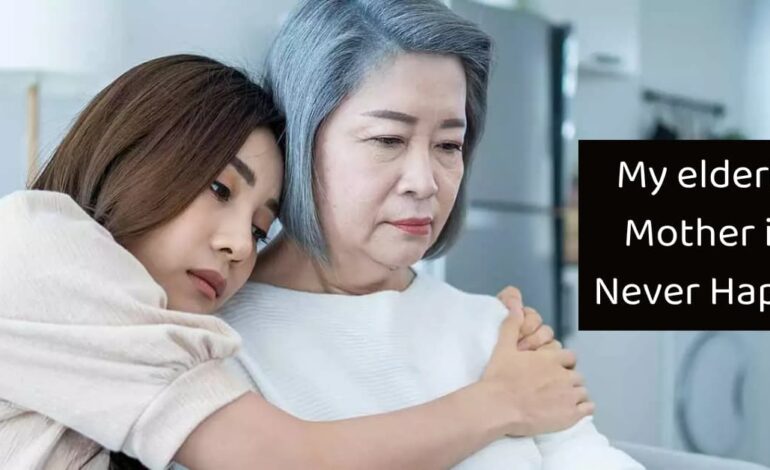
My Elderly Mother Is Never Happy: Real Reasons and What You Can Do
You call her. She complains. You visit. She finds something wrong. You try to make her comfortable. Nothing lands.
If you have been quietly thinking “my elderly mother is never happy,” you probably also feel guilty for even framing it that way. You love her. You are trying. But the constant negativity is exhausting, and somewhere underneath it all you are wondering: is this my fault? Is this normal? And what am I supposed to do about it?
This article will give you honest answers to all three.
First: It Is Probably Not What You Think
Most families assume a chronically unhappy elderly parent is just “difficult” or “set in her ways.” Sometimes that is part of it. But more often, persistent unhappiness in older adults is a symptom of something real and treatable happening beneath the surface.
Chronic pain, depression, loneliness, medication side effects, cognitive decline, and loss of independence are all known drivers of emotional distress in seniors. Many of these go undiagnosed for months or years because older adults often do not say “I am struggling.” Instead, they complain. They criticize. They push people away while actually needing them more than ever.
Understanding this does not mean excusing every difficult behavior. It means starting in the right place: with curiosity instead of frustration.
Common Reasons Your Elderly Mother Is Never Happy
Depression
This is the most important one to understand, and the most commonly missed.
According to the CDC, between 15 and 20 percent of adults over 65 have experienced clinically significant depression. Research published in peer-reviewed journals consistently shows that older women score higher than older men on measures of depressive symptoms, and have higher rates of diagnosed unipolar depression.
Depression in older adults often does not look the way you expect. It rarely presents as someone crying or saying “I feel hopeless.” Instead, it shows up as irritability, constant complaints, physical aches, loss of interest in food or activities, and pushing people away.
If your mother was not always like this and the shift has happened gradually over months or years, depression should be at the top of the list to rule out.
Signs of depression in elderly women to watch for:
- Persistent irritability or negativity that feels out of character
- Loss of interest in things she used to enjoy, hobbies, family visits, TV shows she loved
- Changes in appetite, eating much less or more than usual
- Sleeping significantly more or reporting that she cannot sleep at night
- Fatigue that is not explained by physical illness alone
- Vague physical complaints like headaches or stomach problems with no clear cause
- Withdrawing from people or social situations
- Statements suggesting hopelessness, such as “what is the point” or “I do not care anymore”
Depression is not a normal part of aging, even though it is common. It is treatable. A primary care doctor can screen for it, and a referral to a geriatric psychiatrist or therapist can make a real difference. Do not let anyone tell you “that is just how old people are.”
Loneliness and Social Isolation
The numbers here are significant. According to a 2024 JAMA study drawing from the University of Michigan National Poll on Healthy Aging, roughly one in three adults aged 50 to 80 reports feeling lonely. The CDC notes that social isolation carries a 50 percent increased risk of dementia and is associated with a 29 percent higher risk of heart disease and 32 percent higher risk of stroke.
Almost 30 percent of older adults in the U.S. live alone, which means millions of seniors go entire days without meaningful human contact.
Now think about what that might feel like from the inside. Your mother may have lost her husband. Friends have moved away or passed. Her children have busy lives. Her world has gradually contracted until the highlight of her day is a phone call that lasts seven minutes before someone has to hang up.
When your mother is critical, demanding, or constantly negative, she may not have the words to say “I am desperately lonely.” Complaints about her food, her living situation, or how rarely you visit can all be expressions of something much simpler: she misses feeling connected to people she loves.
Chronic Pain and Physical Discomfort
Pain changes people. This is not a theory. It is something any pain specialist or geriatric care physician will confirm.
When someone wakes up every day with arthritic joints, a sore back, poor digestion, or any of the dozens of chronic conditions that become more common after 70, it grinds away at mood and patience. Things that would not bother a healthy person become almost unbearable. Small irritations feel enormous.
Your mother may have stopped complaining directly about physical pain because she has said it so many times that it no longer seems worth saying. What comes out instead is general dissatisfaction with everything.
Ask her directly about pain. Ask her doctor whether her current pain management is adequate. Undertreated chronic pain is far more common in elderly women than most families realize.
Medication Side Effects
Many older adults take multiple medications, sometimes five, ten, or more. This is called polypharmacy, and it creates significant risk for mood-altering side effects that can be hard to trace back to a specific drug.
Medications for blood pressure, thyroid conditions, pain, acid reflux, and sleep, among many others, can cause or contribute to irritability, anxiety, cognitive fog, and low mood. When a new medication is added or a dosage changes, mood shifts may follow.
If your mother’s unhappiness changed noticeably around the time a new prescription was added, bring that to her doctor’s attention. Ask for a full medication review. A geriatrician or clinical pharmacist can often identify combinations that are causing problems.
Cognitive Decline and Dementia
Early-stage cognitive decline often presents not as obvious memory loss but as personality and mood changes. A mother who was once patient becomes irritable. Someone who used to enjoy company now pushes people away. Frustration rises because she can feel that something is different but cannot name it.
Dementia-related mood changes, including depression and anxiety that accompany cognitive decline, are a recognized clinical phenomenon. The important thing to know is that they can be addressed. Early diagnosis allows for medication and support strategies that improve quality of life.
If you have noticed changes in your mother’s thinking, reasoning, or memory alongside her unhappiness, ask her doctor about a cognitive assessment.
Loss of Control and Independence
This one is harder to pin down but deeply important.
Most elderly women have spent their entire adult lives managing a household, caring for others, making decisions. As they age, those roles erode. Suddenly they need help getting dressed. They cannot drive. Someone else is making decisions about their home, their meals, their schedule.
That loss of autonomy can produce grief, anger, and frustration that has nowhere healthy to go. What you see from the outside as “never being happy” may be a woman mourning the version of herself that used to be in charge of her own life.
This does not mean the situation cannot improve. But it does mean the solution is not to do more for her. It is to find ways for her to retain choice, dignity, and a sense of purpose wherever possible.
Sleep Problems
Poor sleep makes everyone harder to be around. In older adults, sleep disruption is extremely common due to changes in sleep architecture, pain, medications, anxiety, or conditions like sleep apnea.
A mother who is chronically sleep deprived will be irritable, emotionally reactive, and generally negative, not because she has chosen to be but because her nervous system is under constant strain.
Ask about her sleep. Watch for signs of restlessness, frequent nighttime waking, or daytime fatigue. A sleep study ordered by her doctor can sometimes identify something treatable that makes an enormous difference.
What You Can Actually Do
Knowing the cause matters, but you also need practical steps. Here are the ones that research and clinical experience consistently point to.
Talk to Her Doctor, and Be Specific
Do not go in saying “she seems unhappy.” Go in with specifics: when the mood changed, what her sleep is like, what medications she is on, what activities she has stopped doing, and whether she has made any comments suggesting hopelessness.
Bring a written list. Ask specifically whether depression should be screened for. Ask for a full medication review. Ask whether a referral to a geriatric specialist or therapist is appropriate.
Look at What She Has Lost and What She Might Still Have
Instead of trying to “cheer her up” with activities she has no interest in, sit with her and find out what used to matter to her. Not what you think she should enjoy. What she used to love.
Did she garden? Cook? Teach? Were there people she used to talk to regularly that she no longer sees? Can any version of those things be brought back, even in a smaller form?
Meaning and purpose have more impact on mood than most families realize. A senior who feels useful, remembered, and valued in her interests will always do better than one who feels managed.
Do Not Try to Argue Her Out of Her Feelings
When someone says something negative, the natural impulse is to correct it. “That is not true, you have so much to be grateful for.” This almost never helps and often makes things worse.
What works better is acknowledgment. “That sounds really hard.” “I can hear how frustrated you are.” “I am sorry today has been difficult.”
You are not agreeing that everything is terrible. You are letting her feel heard, which is usually what she actually needs.
Increase Real Connection
Not check-in calls. Actual connection.
This means staying long enough to have a real conversation. Asking her about her life, her memories, her opinions. Letting her teach you something. Involving her in a decision. Bringing grandchildren or pets around if that brings her joy.
If your schedule makes this difficult, think about whether other family members could share visits, or whether a companion care service could provide regular social contact between family visits.
Consider Whether Her Living Situation Is Part of the Problem
For many elderly mothers, persistent unhappiness is tied directly to their environment.
If she is living alone and rarely leaving the house, isolation will compound every other issue. If she is in a large care facility where she does not feel seen or known, that sense of anonymity can deepen depression and withdrawal.
Smaller, more personal care settings, like a residential care home where staff know her by name, she eats meals with a small group, and daily routines are built around individual preferences rather than institutional schedules, can make a significant difference in mood and engagement.
At Gift of Love, operated by Gracious Hearts Inc. in Phoenix, families often tell us that a mother who seemed unreachable at home or in a large facility starts to come back to herself in a smaller, warmer environment where she is actually known. The dog companion. The familiar faces. The sense of being part of a small household rather than a unit in a facility. These things matter more than they might sound.
If you are wondering whether a different living environment might help, reach out to Gracious Hearts Inc. for a conversation or explore their Find For Me service to think through what might fit best.
What About You?
This question matters and does not get asked enough.
In 2025, 63 million Americans were providing unpaid care to a family member or friend. Research consistently shows that family caregivers, especially women, experience significantly higher rates of depression, anxiety, and burnout than the general population.
If your mother’s chronic unhappiness is wearing you down, that is not weakness. That is a predictable human response to a genuinely hard situation. Chronic, untreated caregiver burnout can lead to physical and mental health problems, including hypertension, a weakened immune system, depression, and anxiety.
Taking care of yourself is not optional, and it is not selfish. It is the only way you can keep showing up for her with any patience or presence left in the tank.
That means setting limits on what you can reasonably do. Accepting help when it is offered. Talking to someone yourself if you are struggling. And not measuring your worth as a child by whether your mother is happy, because that is a bar no one can clear.
A Final Thought
Your elderly mother’s unhappiness is almost certainly not your fault. And it is almost certainly not permanent or unchangeable.
The causes are real and usually identifiable. Depression, loneliness, pain, medication effects, cognitive changes, and loss of autonomy all respond to the right kind of attention and support. Getting there requires honest conversations with her medical team, patience on your part, and sometimes a change in environment or routine.
You are already doing something right by looking for answers instead of giving up.
If your family is in the Phoenix area and you want to explore whether a more personal care setting might be part of the solution, the team at Gracious Hearts Inc. is available to talk. Call (480) 705-9118 or book a visit online.