Small Residential Care Home vs. Large Assisted Living Facility: Pros & Cons
What type of senior care truly offers the right balance of comfort and independence?
Assisted living is a supportive care option designed for seniors who need help with daily activities like bathing, meals, medication, and mobility.
Choosing between a small assisted living home vs large facility can feel overwhelming for families. The main difference between a small assisted living home vs large facility is scale and personalization.
Small homes house 5 – 10 residents and provide higher caregiver-to-resident ratios, often 1:3. Large facilities house 50 – 200+ residents and offer more amenities, structured activities, and specialized medical services, but less individualized attention.
By the end of this guide, you’ll have a clear understanding of how each option works, what they offer, and which type of assisted living best matches your loved one’s needs, lifestyle, and long-term care expectations.
Let’s see how it works!
What Is a Small Assisted Living Home?
A small assisted living home is a type of senior care setting that accommodates around 6 to 20 residents. They offer a much more intimate and residential-style environment compared to larger senior living communities.
In many cases, these homes are also referred to as a Board and Care Home, where seniors receive daily support in a setting that feels closer to a private family residence rather than a medical or institutional facility.
A Home-Like Environment That Feels Familiar
These residences are usually located in normal residential neighborhoods and are designed to feel warm, calm, and comfortable.
Instead of long hallways or busy shared areas, residents live in a smaller and quieter space with fewer people around. Daily life also follows a relaxed routine that feels closer to normal household living.
Daily life also follows a relaxed routine that feels closer to normal household living. It’s a comfortable choice for those considering short term stay assisted living in a less institutional environment.
Highly Personalized Care and Daily Support
With fewer residents and a higher caregiver-to-resident ratio (often around 1:3), staff are able to give more personal and focused care throughout the day.
This means residents get help with daily activities like bathing, dressing, and grooming. Staff also support with medication reminders and management to ensure everything is taken on time.
Meals are prepared according to each person’s dietary needs, and caregivers provide support with movement mobility and general daily supervision.
For families who prefer professional caregiver support in a more flexible setting, Gracious Hearts Inc provides trained caregivers who assist with daily living activities, companionship, and personal care
Who They Are Best Suited For
Small assisted living homes are often a strong fit for:
- Seniors who value privacy and familiarity
- Individuals with mild to moderate care needs
- Those who may struggle in large, noisy environments
- Residents who benefit from consistent caregiver relationships
If families are exploring personalized in-home or assisted support options, Gracious Hearts Inc offers professional caregivers who provide compassionate, one-on-one care tailored to individual senior needs.
What Is a Large Assisted Living Facility?
A large assisted living facility is a structured senior care environment designed to support a high number of residents ranging from 50 to 300+ seniors under one coordinated system.
These communities are commonly known as Assisted Living Communities, and they operate on a larger, more organized scale compared to smaller residential care homes.
Structured, Campus-Like Living Environment
Large assisted living facilities are often designed to feel like a hotel-style or campus-like setting, with organized floors, dining halls, activity rooms, and shared social spaces.
Daily routines are usually more scheduled, with set times for meals, medication rounds, recreational activities, and wellness programs.
Care System and Staffing Model
Care is delivered by a team that includes a nursing staff, caregivers, activity coordinators, and medical support personnel.
Staff usually operate in shifts, meaning residents may interact with different caregivers throughout the day.
This system ensures 24/7 coverage and medical oversight, which is especially important for seniors with complex health needs.
Lifestyle, Amenities, and Social Environment
Residents can take part in group activities and social programs that help them stay active and connected with others.
These communities often include fitness and wellness areas where residents can exercise and maintain their health.
There are also entertainment spaces and regular community events to keep daily life engaging and enjoyable. In addition, some facilities offer specialized care services such as therapy or memory support for residents.
Who They Are Best Suited For
- Seniors who enjoy a social and active community lifestyle
- Individuals who prefer structured daily routines and scheduled activities
- Seniors needing regular medical supervision and support
Small Assisted Living Home vs Large Facility: Key Differences
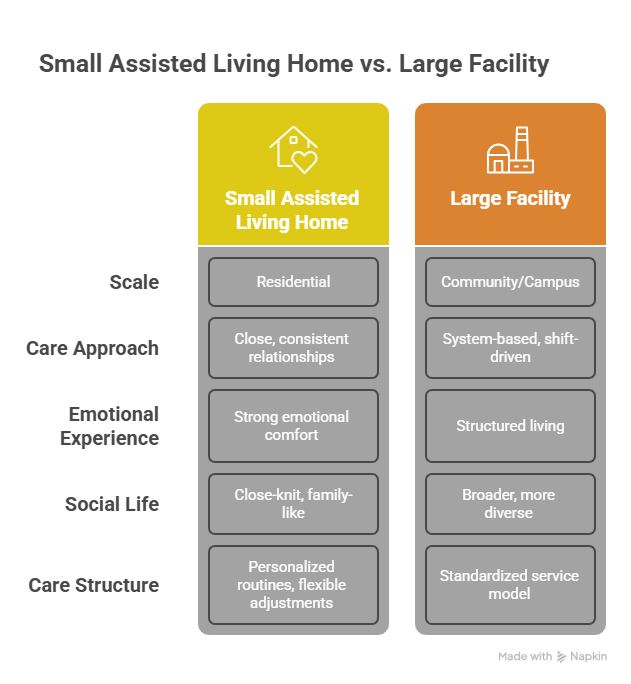
This comparison is about lifestyle, emotional comfort, level of personalization, and how care is structured day to day within an Assisted Living Facility.
1. Scale and Living Environment
Small assisted living homes operate on a residential scale, often caring for just a handful of seniors in a quiet, home-like setting. This creates a more intimate atmosphere.
In contrast, large facilities operate on a community or campus scale. It houses dozens to hundreds of residents. These environments are more structured, with clearly defined spaces for dining, recreation, healthcare, and social activities.
2. Care Approach and Personal Attention
In small homes, a Caregiver usually develops close, consistent relationships with residents. Care tends to be more flexible, with routines adjusted based on individual needs.
In large facilities, care is more system-based and shift-driven. While professional support is always available, caregiving is distributed among larger teams, which can limit one-on-one familiarity.
3. Emotional Experience vs Structured Living
Small assisted living homes are often associated with a stronger emotional and psychological comfort level. The environment feels personal, quiet, and stable.
Large facilities, on the other hand, emphasize structured living. Daily schedules, organized activities, and community events create predictability and social engagement.
4. Social Life and Daily Interaction
In smaller homes, social interaction is typically close-knit and family-like, with fewer residents forming deeper bonds.
In large facilities, social life is broader and more diverse. It offers multiple activities, group programs, and opportunities to meet new people regularly.
5. Care Structure and Service Delivery
Small homes prioritize personalized routines and flexible care adjustments, often adapting quickly to individual health or emotional needs.
Large facilities follow a more standardized service model, where care is delivered through organized systems designed to support many residents efficiently.
Cost Comparison Between Small Homes and Large Facilities
The concept of Assisted Living Cost varies widely across regions, but the cost structure follows consistent global patterns.
Small Assisted Living Homes (Residential Care Homes)
- Approx. $2,000 -$4,500 per month (USD equivalent in many Western markets)
- Lower-cost regions may fall significantly below this range
- Higher-care or private rooms may increase costs
Large Assisted Living Facilities
- Approx. $4,000 – $7,500+ per month
- Premium communities with luxury amenities can exceed this range
- Memory care or specialized medical support increases pricing further
Which Is Better for Dementia or Alzheimer’s Patients?
There is no universal “best” option; what matters most is matching the care environment to the stage of memory decline and the individual’s emotional and medical needs.
Small Assisted Living Homes: Better for Calm, Low-Stimulation Care
Small assisted living homes are often considered more suitable for early to moderate stages of memory-related conditions because they provide a quiet, familiar, and low-disruption environment. The key advantages are-
- Lower noise levels and fewer distractions
- More consistent routines that reduce confusion
- Familiar surroundings that feel less overwhelming
- Stronger one-on-one caregiver relationships
- Easier adaptation for residents who get anxious in busy environments
Large Facilities: Better for Structured Medical Supervision
Large assisted living communities provide stronger clinical structure and are often equipped with dedicated Caregiver teams, nurses, and specialized care units. The key advantages are-
- 24/7 medical monitoring and emergency response systems
- Access to specialized memory care programs
- Structured routines for medication and therapy
- Higher staffing coverage for complex health needs
- On-site support for advanced stages of cognitive decline
Emotional Comfort vs Medical Structure
The key difference lies in the type of support being prioritized:
- Small homes: Focus on emotional comfort, familiarity, and reduced confusion
- Large facilities: Focus on safety systems, medical supervision, and structured care plans
In Dementia Care, emotional stability is just as important as physical safety. For this reason, environmental sensitivity becomes a major deciding factor.
FAQs
What is the main difference between a small assisted living home vs large facility?
A small assisted living home has 5 – 20 residents and offers more personalized, home-like care with closer caregiver relationships. A large facility, often part of an Assisted Living Facility, serves 50 – 300+ residents and provides more structured services, organized activities, and access to broader medical support systems.
Is a small assisted living home cheaper?
Yes. Small homes generally have lower operational costs, such as staffing, utilities, and maintenance, making them more affordable. However, pricing still depends on location, level of care, and services provided under Assisted Living Cost.
Are large assisted living facilities safer?
Large facilities often provide stronger medical oversight and emergency response systems, which can improve safety for seniors with complex health needs. Smaller homes may offer better supervision due to lower resident numbers and closer caregiver interaction.
Which option provides better care?
It depends on the individual’s needs. Small homes usually offer more personalized, relationship-based care, while large facilities provide structured, medically supported care systems.
Bottom Line
The choice between a small assisted living home vs large facility comes down to personalization vs services within the Assisted Living Model.
Small homes offer a quiet, home-like setting with more personal care and close caregiver attention. Large facilities provide more services, activities, and stronger medical support, which suits seniors who enjoy social life and need regular health monitoring.
In the end, the best option depends on whether the priority is more personal attention or more facilities and structured care.
For families seeking compassionate, reliable, and flexible senior care solutions, Gracious Hearts Inc stands as a trusted option for professional caregiving services designed to support senior independence
Good luck!