
How To Convince Parent To Go To Assisted Living: A Gentle Approach
What do you do when you know your parent needs more support, but every time you mention assisted living, they immediately say “no”?
Learning how to convince a parent to go to assisted living is not about forcing a decision; it is about helping an elderly parent feel safe, respected, and still in control.
The best way to encourage a parent to consider assisted living is by starting calm conversations about current challenges, such as managing home tasks, health needs, meals, medication, or loneliness.
Involve trusted professionals like doctors or neutral family advisors when needed, and visit facilities together.
In this guide, you will learn how to talk to a parent who refuses assisted living, when to involve a doctor or neutral third party, and how to handle guilt after the decision.
Therefore, let’s walk through it!
Quick Answer: How to Convince Parent to Go to Assisted Living?
You don’t convince them in one conversation and trying too often makes things harder. What actually works is a gradual, empathy-first approach built on trust.
Start by listening more than talking. Understand what your parent fears most; losing independence, feeling abandoned, or simply not knowing what modern assisted living looks like today.
Then address those fears directly, one at a time. Involve their doctor if the conversation keeps stalling.
Suggest a no-pressure tour before any decision is made. And when resistance rises, step back. Give the idea time to settle rather than forcing a conclusion.
Most families need several conversations over weeks or months before a parent feels ready. That’s normal.
How to Talk to a Parent Who Refuses Assisted Living?
These practical tips can help you start supportive conversations, reduce resistance, and help your parent feel more involved, understood, and in control of the decision.
1. Listen Before You Convince
Start by asking what your elderly parent wants to protect: independence, privacy, comfort, safety, and daily routine.
AARP recommends discussing future housing choices early and collaboratively instead of waiting for a crisis.
Ask What Matters Most to Them
Use calm, open questions:
- “What feels hardest to manage at home right now?”
- “What kind of help would make daily life easier?”
- “What would help you feel safer without losing independence?”
- “What worries you most about assisted living?”
These questions help your aging parent feel respected, not controlled.
2. Avoid Making the First Conversation About Moving
The first family conversation should focus on needs, not relocation.
Talk about practical concerns such as medication, meals, housekeeping, transportation, loneliness, stairs, or health appointments.
Once your parent feels heard, it becomes easier to discuss senior living as one possible care option.
3. Give Them Time Instead of Forcing One Big Decision
If your parent refuses assisted living, pushing harder may only make them more resistant. A major care decision can feel overwhelming, especially when an aging parent already fears losing control.
The Arbor Company recommends “backing off temporarily” when the conversation is not working, because a pause can give your parents time to reflect instead of feeling pressured.
4. What to Say When Your Parent Refuses Assisted Living
When your parent says no, the conversation doesn’t have to end there. What you say next, and the way you say it, can either keep the conversation open or shut it down completely.
Try phrases like:
“I’m not asking you to decide anything today. I just want to understand what worries you most.” This removes the pressure of a decision and invites honest conversation.
“I want you to keep as much independence as possible, that’s exactly why I want us to look at options together.” This reframes assisted living not as a loss of freedom.
“What would make you feel comfortable enough to just take a look?” This hands control back to your parent.
“I’m not going anywhere. I just don’t want to wait until there’s a crisis before we talk about this.” This expresses love and urgency.
When your parent refuses assisted living, the better move is to slow down, ask more questions than you answer, and make it clear that their voice matters most in this decision.
5. What Not to Say to an Aging Parent
Here are the phrases most likely to backfire, and why:
“You can’t live alone anymore.” Even if this is medically true, it strips your parent of dignity in a single sentence. It sounds like a verdict, not a conversation.
“We’ve all talked about this and we agree.” Presenting a family consensus feels like an ambush to a parent who wasn’t part of that conversation.
“You’re being selfish / stubborn / unreasonable.” This shuts down communication immediately.
“I can’t keep doing this.” Even when caregiver burnout is real and valid, framing it this way places the emotional weight of your exhaustion on your parent.
“It’s not safe for you to be here.” Delivered bluntly, this can feel like an eviction rather than an expression of care.
6. Involve a Doctor or Trusted Third Party
If your conversations keep turning into arguments, involve a neutral third party such as a doctor, geriatric care manager, trusted family member, close friend, or faith/community leader.
A doctor can be especially helpful when there are clear safety concerns, such as falls, missed medication, poor nutrition, memory changes, or difficulty managing daily activities.
7. Use the “Tour It, Not Commit to It” Approach
Many parents picture an outdated nursing home when they hear “assisted living,” but modern assisted living is usually focused on daily support, meals, personal care, safety, and social connection.
Instead of saying, “You need to move,” try: “Let’s just visit one place and see what it feels like. We do not have to decide anything today.”
During the tour, encourage them to notice practical details: staff interaction, room privacy, meals, activities, safety features, and how residents spend their day.
A no-pressure tour at a place like Gift of Love in Phoenix can help your parent see what modern assisted living actually looks like.
Gift of Love is an assisted living facility offering senior care services, including personal care assistance with daily activities such as bathing, dressing, grooming, and medication management.
8. Know When Safety Requires a More Serious Step
If your parent’s refusal puts their health or safety at risk, the conversation may need to move to protection.
Warning signs include repeated falls, missed medication, poor nutrition, unsafe cooking, wandering, frequent emergencies, or serious caregiver burnout.
Falls are especially important to address, as the CDC reports that falls are the leading cause of injury for adults aged 65 and older.
Note missed doses, recent falls, forgotten stove use, or repeated hospital visits. Then involve a trusted doctor, care manager, or other neutral professional who can explain risks clearly.
9. Handle Guilt After the Decision
Feeling caregiver guilt after moving a parent to assisted living is normal.
Many adult children wonder if they gave up too soon, especially when the decision involved fear, disagreement, or a sudden health concern.
AARP notes that caregivers often face “no-win” situations where someone may feel hurt, even when the caregiver is doing the best they can.
Try to reframe the move as an act of safety and support, not abandonment. Assisted living can provide daily help, meals, medication support, social connection, and a safer environment.
Why Your Parent May Resist Assisted Living?
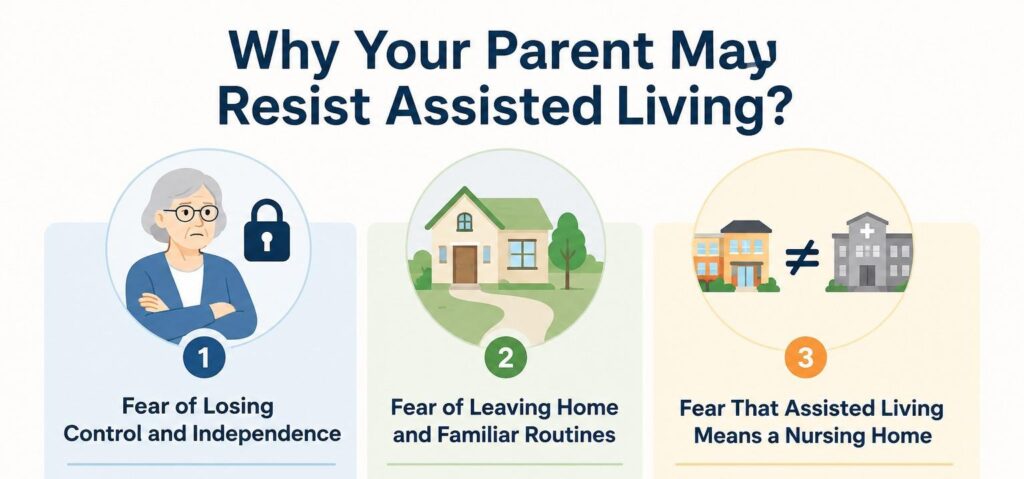
The National Institute on Aging notes that many older adults want to age in place, but doing so requires realistic planning around safety, mobility, and daily support.
1. Fear of Losing Control and Independence
For many aging parents, assisted living can feel like someone else is taking over their life. They may worry about losing control over daily routines, personal choices, and privacy.
To reduce this fear, frame assisted living as support for independence. Assisted living is generally for people who need help with daily care but do not need the higher level of medical care.
2. Fear of Leaving Home and Familiar Routines
Instead of saying, “You need to move,” start by discussing current challenges such as cooking, cleaning, medication, stairs, loneliness, or safety at home.
This keeps the conversation practical and less threatening.
3. Fear That Assisted Living Means a Nursing Home
Clarify the difference: assisted living usually provides help with daily activities, meals, housekeeping, social engagement, and personal care, while nursing homes provide more intensive medical or skilled nursing support.
What If Your Parent Has Dementia or Memory Problems?
The usual approaches to patience and persuasion still matter, but they need to be adapted to what dementia does to a person’s ability to reason, remember, and feel safe.
The Conversation Changes With Dementia
According to the Alzheimer’s Association, dementia progressively impairs judgment and the ability to process new information.
Your parent may agree one day and refuse the next. They may not remember the conversation at all by the following morning.
Instead of trying to convince, focus on reassuring. Keep sentences short and warm. Use familiar references. Don’t correct or argue.
Feelings Last Longer Than Facts
The Alzheimer’s Society notes that emotional memory tends to outlast factual memory in people with dementia.
Your parent may forget what you said, but they will remember how the conversation made them feel. This makes tone more important than argument.
A calm, loving presence during these conversations does more practical good than a well-reasoned case.
When Your Parent Can No Longer Decide Safely
A time comes when a parent with dementia can no longer make safe decisions about their own care. When that happens, families have legal options:
Power of Attorney (POA): If your parent previously granted a family member authority over healthcare decisions, that person can now act on their behalf.
Guardianship: Where no POA exists, legal guardianship through the courts may be necessary. An elder law attorney can guide this process.
Physician documentation: A formal cognitive assessment from a geriatric specialist provides the medical foundation needed to support the transition to care.
Memory Care vs. Standard Assisted Living
If your parent has a dementia diagnosis, a dedicated memory care community is likely the safer and more appropriate choice over standard assisted living.
According to the National Center for Assisted Living (NCAL), memory care environments offer secure layouts that minimize wandering risk, staff trained specifically in dementia communication, and structured routines that reduce daily confusion and anxiety.
Alternatives to Assisted Living If They Refuse

Here are the most practical, widely used alternatives worth exploring together.
1. In-Home Care
For parents set on staying home, professional in-home care lets them do exactly that with added support.
A trained caregiver can assist with bathing, dressing, meals, and medication reminders, while your parent stays in the environment they know.
The National Institute on Aging recognizes in-home care as one of the most effective bridges for older adults not yet ready for residential care.
The limitation: it can be costly.
2. Adult Day Programs
Adult day programs offer structured daytime support – activities, health monitoring, meals, and social interaction while your parent continues living at home.
They’re one of the most underutilized resources in senior care. For a parent resistant to any permanent change, these programs offer a low-pressure first step into structured support.
3. Independent Living Communities
If your parents’ resistance is less about moving and more about the implication that they need care, an independent living community can reframe the conversation entirely.
These communities offer private residences, social programming, and optional services, without the clinical structure of assisted living.
4. Home Modifications
The CDC estimates one in four adults over 65 experiences a fall each year. Most of them are at home, in preventable situations.
Grab bars, improved lighting, non-slip flooring, and stair railings can meaningfully reduce risk without disrupting your parent’s routine.
FAQs
1. How do I talk to elderly parents about assisted living?
Start with calm questions instead of pressure. Ask what feels difficult at home, what support they would accept, and what helps them feel independent. AARP recommends discussing future housing choices early and collaboratively, not only during a crisis.
2. What should I do if my elderly parents refuse assisted living?
Do not force a big decision. Give them time, listen to their fears, and return to the conversation later. Focus on safety, daily support, meals, medication, loneliness, and quality of life rather than simply saying they need to move.
3. When is assisted living the right option?
Assisted living may be worth considering when an aging parent needs help with daily tasks but does not need full nursing-home-level medical care. It can support meals, personal care, housekeeping, medication routines, and safer day-to-day living.
4. How can I make assisted living feel less scary for my parent?
Use the “tour it, not commit to it” approach. Visiting an assisted living facility together helps your parents see the environment before making a decision. This can reduce fear, correct outdated assumptions, and make the conversation feel more practical than threatening.
5. Can You Force a Parent to Move to Assisted Living?
No, you usually cannot force a parent to move to assisted living if they are mentally capable of making their own decisions. However, if severe cognitive decline or safety risks are involved, families may need to explore legal options like guardianship or power of attorney.
Final Thoughts
Convincing a parent to consider assisted living is not really about winning an argument. It is about helping someone you love feel safe, heard, and respected during a difficult life change.
Your parents may resist because they fear losing independence, leaving home, or being treated as if they no longer have a voice.
Start with listening. Use gentle words. Focus on safety, daily support, comfort, and quality of life. When the time feels right, suggest a no-pressure tour so your parent can see what modern assisted living actually looks like before making any decision.
A visit to a caring place like Gift of Love in Phoenix can make the idea feel less frightening and more real, especially if your parents still imagine assisted living as an outdated nursing home.