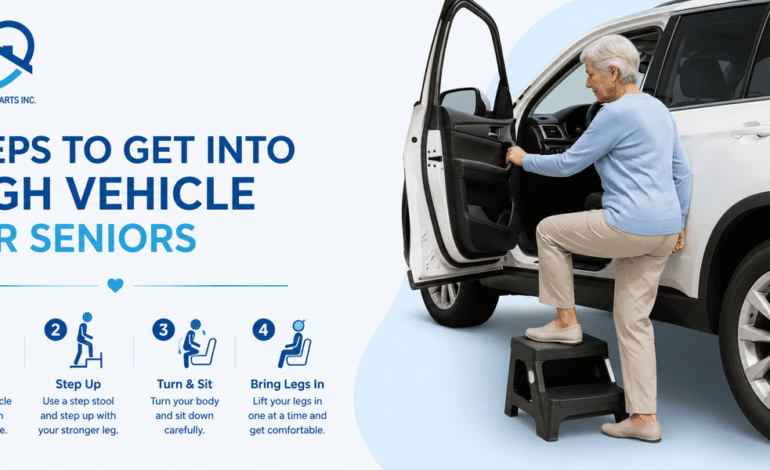
Steps to Get Into a High Vehicle for Seniors: A Safe, Easy Guide
Getting into an SUV, truck, or minivan should not feel like a workout. But for many seniors, that high step up has become a genuine source of stress, and sometimes a real fall risk.
The good news is that with the right technique, a few simple tools, and a little patience, getting in and out of a tall vehicle can be done safely and confidently. This guide walks through exactly how, step by step, for seniors doing it themselves and for caregivers helping someone else.
Why High Vehicles Are Harder to Get Into as You Age
A few things change with age that make this task more difficult than it used to be:
- Reduced hip and knee mobility makes lifting a leg up and over a high step harder
- Lower leg strength means less power to push the body upward
- Balance changes make standing on one leg, even briefly, feel unstable
- Joint stiffness, especially in the morning or in cold weather, adds resistance to movement
- Fear of falling itself can cause hesitation and tension, which paradoxically increases fall risk
This is not a small or rare problem. According to the CDC, over 14 million adults aged 65 and older, about 1 in 4, report falling each year, and roughly 37% of those falls cause an injury serious enough to need medical attention. Falls are the leading cause of injury-related death in this age group, and the rate has been climbing in recent years.
Getting in and out of a vehicle is one of the most common everyday moments where a fall can happen. Knowing the right technique matters.
Step-by-Step: How to Get Into a High Vehicle Safely
Follow this sequence every time. Once it becomes a habit, it gets easier and faster.
1. Park on flat, stable ground. If possible, avoid parking on a slope, gravel, or uneven pavement. A flat surface gives you the most stability.
2. Open the door fully and check the area. Make sure there is nothing in the way and the path to the seat is clear.
3. Stand close to the vehicle, facing away from the seat. Back up to the seat the way you would sit down in a chair, rather than climbing in sideways or facing forward.
4. Find a stable grab point. Use the interior grab handle if the vehicle has one (many SUVs and trucks do, usually mounted on the A-pillar near the windshield). Avoid grabbing the door itself, since it can swing and throw off your balance.
5. Lower yourself down using your legs, not your arms. Bend your knees and sit back into the seat the same way you would sit into a chair. Keep your knees together as you do this for added stability.
6. Sweep both legs in together. Once you are seated, lift and rotate both legs into the vehicle as one motion rather than lifting them separately. Use your hands to help guide your thighs if needed.
7. Settle into position and buckle up.
Step-by-Step: How to Get Out of a High Vehicle Safely
1. Unbuckle first, before doing anything else.
2. Sweep both legs out together, keeping your knees close, and place your feet flat on the ground.
3. Scoot forward slightly so your weight is closer to the edge of the seat.
4. Hold the grab handle or a stable interior point, not the door.
5. Stand up using your legs, pushing through your feet rather than pulling with your arms.
6. Pause for a second before walking to make sure your balance feels steady, especially if you are getting out after sitting for a long drive.
Tools That Make This Easier
A few simple, inexpensive tools can make a real difference, especially for vehicles that sit particularly high off the ground.
Portable step stools. Purpose-built senior step stools, like the Shure-Step brand, are different from a regular household step stool. They have a wide non-slip surface, a wedge-shaped stable base, and a high weight capacity. These are designed specifically to bridge the gap for entering trucks, SUVs, and vans, and they fold flat for storage in the vehicle.
Grab handles and assist straps. Aftermarket assist handles can be added to vehicles that do not already have one, giving a stable point to hold onto that does not rely on the door.
Seat cushions. For lower vehicles like sedans, a firm seat cushion raises the seat height slightly, reducing how far you need to lower yourself.
Swivel seats. For seniors with more significant mobility limitations, a swivel seat base can be installed that rotates outward, allowing someone to sit down facing outside the vehicle before swiveling into position. This removes much of the twisting and lifting involved in a standard transfer.
Transfer plates and person hoists. For wheelchair users or those with very limited mobility, a transfer plate allows sliding from a wheelchair into the vehicle seat, and a person hoist can lift someone in and out without manual lifting. These are typically installed by a mobility equipment specialist following an assessment.
A Note for Caregivers: How to Help Without Hurting Yourself
If you are assisting a parent or loved one, your own body mechanics matter just as much as theirs. Caregivers frequently injure their backs and shoulders while helping with vehicle transfers, often because they try to physically lift or pull someone rather than guide them.
A few principles to follow:
Plan before you move. Make sure the car is parked, the handbrake is on, and the seat is adjusted for comfort before starting the transfer.
Face each other when possible. This gives the person something stable to hold and lets you support their weight more evenly.
Bend your knees, not your back. If you need to support weight, lower yourself by bending your knees and keep your spine straight, the same principle used when lifting anything heavy.
Let them do as much of the movement as they safely can. Encourage your loved one to use grab handles and push through their own legs. Your role is to provide stability and confidence, not to do the lifting for them.
Move slowly and communicate. Rushing increases the risk of a misstep for both of you. Narrate each step out loud, “okay, now we are going to sit back,” so there are no surprises.
Ask for help when something feels unsafe. If a transfer consistently feels difficult or risky, it may be time to look into a mobility assessment or adaptive equipment rather than continuing to manage it manually.
When It Might Be Time to Rethink the Vehicle Itself
Sometimes, no amount of technique or equipment fully solves the problem. If getting in and out of a vehicle has become consistently difficult, painful, or frightening despite trying the steps above, it is worth having an honest conversation about whether a different vehicle, or a different daily transportation plan, makes more sense.
Vehicles with a lower step-in height, smaller SUVs, sedans with a firm seat cushion, or vehicles specifically chosen for senior accessibility, can remove the problem entirely rather than working around it. An occupational therapist can also perform a mobility assessment and recommend the right adaptations for a specific situation.
This kind of difficulty can also be one small but meaningful sign that daily life is getting harder to manage independently. If you are noticing this along with other challenges, getting around the house safely, managing meals, staying socially connected, it may be worth a broader conversation about what kind of support actually makes daily life easier and safer.
For families in the Phoenix area exploring what additional support might look like, the team at Gracious Hearts Inc. is happy to talk through options, whether that means in-home support or a more structured care setting like Gift of Love, where transportation, mobility, and daily safety are part of everyday care.
The Bottom Line
Getting into a high vehicle safely comes down to technique: facing away from the seat, using a stable grab point instead of the door, lowering with your legs, and sweeping both legs in together. Add the right tools where needed, and the task becomes far less stressful and far safer.
If you are a caregiver, your own body mechanics matter just as much as the technique you are teaching. And if the struggle continues despite trying all of this, it may be a signal worth paying attention to rather than working around indefinitely.
If you have questions about senior mobility, transportation, or care support in the Phoenix area, you can reach Gracious Hearts Inc. at (480) 705-9118 or schedule a conversation online.
Related Reading on the Gracious Hearts Blog:
