
Caregiver Burnout Signs and Symptoms You Should Never Ignore
What if the person quietly falling apart isn’t the one receiving care, but the one giving it?
Caregiver burnout is real, and it rarely announces itself. It creeps in slowly, disguised as just “a hard week” or “feeling a little off lately.”
However, the caregiver burnout signs and symptoms can build quietly and deteriorate your emotional resilience, physical wellness, and even the ability to provide proper care.
At its core, common caregiver burnout signs and symptoms include chronic fatigue, irritability, anxiety, sleep problems, social withdrawal, and difficulty concentrating.
Many family caregivers also experience caregiver exhaustion, frequent illness, feelings of hopelessness, mood swings, and loss of interest in daily activities after months or years of ongoing stress.
This article breaks down 12 clear warning signs of caregiver burnout you should never ignore, from emotional withdrawal and caregiver exhaustion to physical symptoms and resentment.
So, let’s dive a little deeper!
The 12 Caregiver Burnout Signs and Symptoms to Watch For
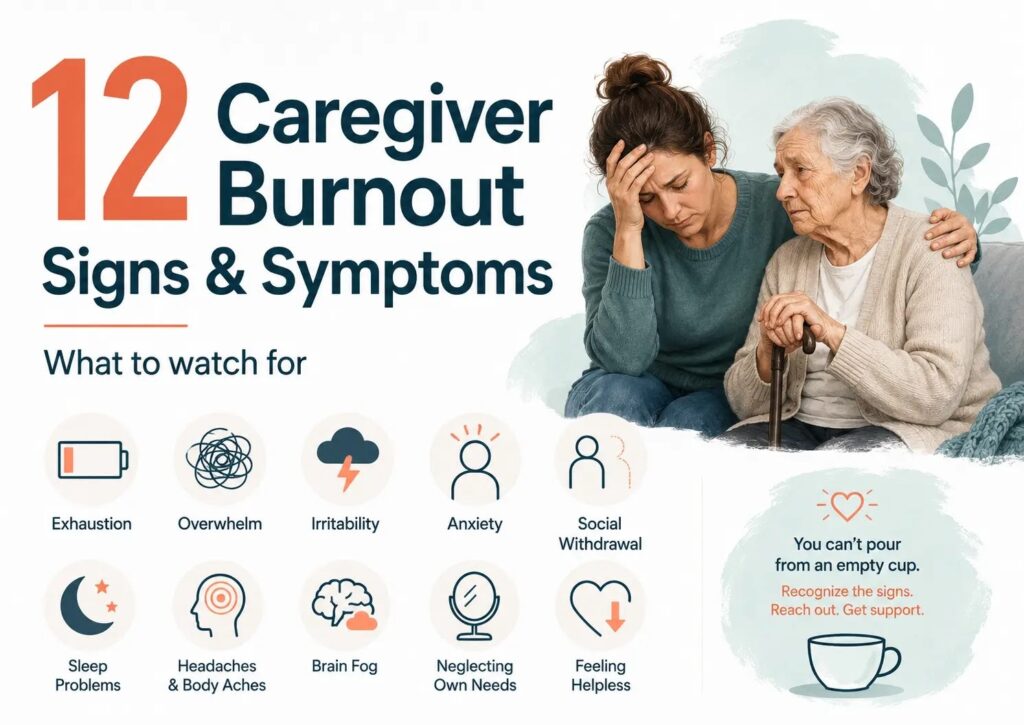
For some caregivers, it begins physically, through exhaustion, frequent illness, headaches, or sleep problems.
For others, it shows up emotionally, through resentment, numbness, crying, irritability, or a quiet sense of not being able to continue.
1. Physical Signs of Caregiver Burnout
- Constant Exhaustion
There’s tiredness, and then there’s the kind of bone-deep, relentless exhaustion that sleep simply cannot touch.
If you’ve been waking up after a full night’s rest still feeling completely drained, or struggling to get through tasks that once felt effortless, this is one of the earliest and most telling signs of caregiver burnout.
If caregiving has brought you or your family to a place of exhaustion, it is a sign that you need and deserve support. Gift of Love by Gracious Hearts Inc offers structured respite care and compassionate professional assistance.
It creates the space for caregivers to step back, recover, and return to their role feeling human again.
- Sleep Problems
Poor sleep from caregiving creates a vicious cycle. The less you sleep, the less capacity you have to manage stress.
The more stress accumulates, the harder it becomes to sleep. Over time, chronic sleep deprivation deepens every other symptom of burnout.
- Weight Changes
Noticeable changes in appetite. It means skipping meals regularly, eating significantly more than usual, or experiencing unexplained weight gain or loss over a period of weeks.
- Frequent Illness, Headaches, or Body Aches
Under prolonged psychological pressure, the body’s ability to defend itself weakens, and the result is that burned-out caregivers often find themselves getting sick more frequently.
Recurring headaches, body aches, tension in the neck and shoulders, digestive problems, and a general sense of physical fragility are all caregiver physical symptoms.
- Neglecting Your Own Needs
Self-neglect in caregiving is insidious because it comes dressed as selflessness. But consistently placing your own health at the bottom of the priority list is not noble; it’s unsustainable.
2. Emotional Signs of Caregiver Burnout
- Feeling Overwhelmed, Helpless, or Hopeless
There’s a particular kind of emotional weight that comes with caregiving, the sense that no matter how hard you try, it’s never quite enough.
When that feeling changes from occasional frustration to something constant that stays with you day and night, it may be a major warning sign of caregiver burnout.
- Irritability, Anger, or Frustration
You felt a flash of rage or frustration in a moment when you expected to feel compassion. You’ve been short-tempered with people you love, and then felt the guilt of it long after the moment passed.
Mood changes, impatience, and caregiver frustration are among the most common symptoms of caregiver burnout.
- Anxiety, Constant Worry, or Feeling on Edge
As a caregiver, a certain level of concern is natural. You’re responsible for someone’s health, safety, and well-being.
But there’s a meaningful difference between thoughtful attentiveness and a state of constant worry that never switches off.
- Sadness, Low Mood, or Loss of Motivation
Persistent sadness, a lingering emotional heaviness, and a loss of motivation to engage with daily life are all signs of caregiver emotional burnout that should not be dismissed.
- Social Withdrawal From Family and Friends
Social withdrawal is one of the quietest signs of caregiver burnout, partly because it happens so gradually that neither you nor the people around you notice the drift until it’s significant.
According to the 2025 Caregiving in the U.S. report by AARP and the National Alliance for Caregiving, nearly one in four family caregivers reports feeling socially isolated.
- Losing Interest in Hobbies
Before caregiving consumed your schedule, you had a life that was distinctly yours.
Now, those things feel distant. Either there’s no time, or on the rare occasions time appears, you simply don’t feel like yourself enough to use it.
- Trouble Concentrating or Mental Fog
Caregiver brain fog is a real and well-documented consequence of sustained mental overload.
When your mind is always handling daily tasks, worrying about a loved one’s health, dealing with emotions, and getting too little rest, it becomes harder to stay focused and remember things clearly.
What Causes Caregiver Burnout?
Below are the most significant causes that most caregivers never see coming until they’re already deep.
1. Long Caregiving Hours With No Real Break
Many family caregivers are effectively on call around the clock, managing medications, monitoring symptoms, handling nighttime needs, and coordinating appointments on top of their own lives.
When hours stretch without genuine rest, the body and mind do not recover. Fatigue compounds.
And what began as an act of love starts to feel too much, not because the love has gone, but because no human being can sustain that level of output without restoration.
Families who place loved ones at Gift of Love often tell us the guilt faded once they saw how happy and cared-for their parent became, and they felt relieved.
2. Role Confusion and Loss of Personal Identity
One of the most emotionally difficult causes of burnout is trying to manage several roles at the same time.
AARP points out that many caregivers are not only caregivers, but also spouses, parents, employees, or family members with many other responsibilities.
Over time, these roles start to overlap. Your relationship with your loved one may change, and daily life can begin to feel emotionally confusing and overwhelming.
3. Lack of Help, Support, or Shared Responsibility
The absence of a reliable support system is one of the clearest contributing factors to burnout.
When there is no one to step in during an emergency, no one to share the overnight responsibilities, and no community or professional network to draw on, caregivers carry a disproportionate weight.
4. Financial Strain
Many caregivers reduce their working hours, turn down promotions, or leave employment altogether to meet caregiving demands.
At the same time, out-of-pocket costs for medical equipment, home modifications, medications, and professional support services add up quickly.
5. Unrealistic Expectations
AARP highlights unrealistic expectations as one of the most underappreciated drivers of caregiver burnout, and it manifests in two directions.
The first comes from outside: family members, healthcare providers, or cultural norms that assume a caregiver can and should do everything without complaint, without limits, and without additional support. The second comes from within.
The Guilt Cycle That Keeps Caregivers Stuck
Caregiver burnout often becomes harder to escape because of guilt. Many caregivers feel guilty for needing rest, asking for help, losing patience, feeling resentful, or considering outside care.
This guilt can create a painful cycle.
First, the caregiver becomes physically and emotionally drained. Then they feel guilty for being tired or overwhelmed.
To make up for that guilt, they push themselves harder, skip breaks, ignore their own needs, and keep carrying the full responsibility alone.
Over time, burnout gets worse. The caregiver may become more irritable, emotionally numb, anxious, tearful, or hopeless.
Then, because these feelings do not match what they believe a “good caregiver” should feel, the guilt returns even stronger.
The cycle often looks like this:
Exhaustion → guilt → overgiving → deeper burnout → emotional overwhelm → more guilt
This is why many caregivers stay stuck. Guilt makes help feel like failure, even when support is exactly what is needed.
How to Recover from Caregiver Burnout?
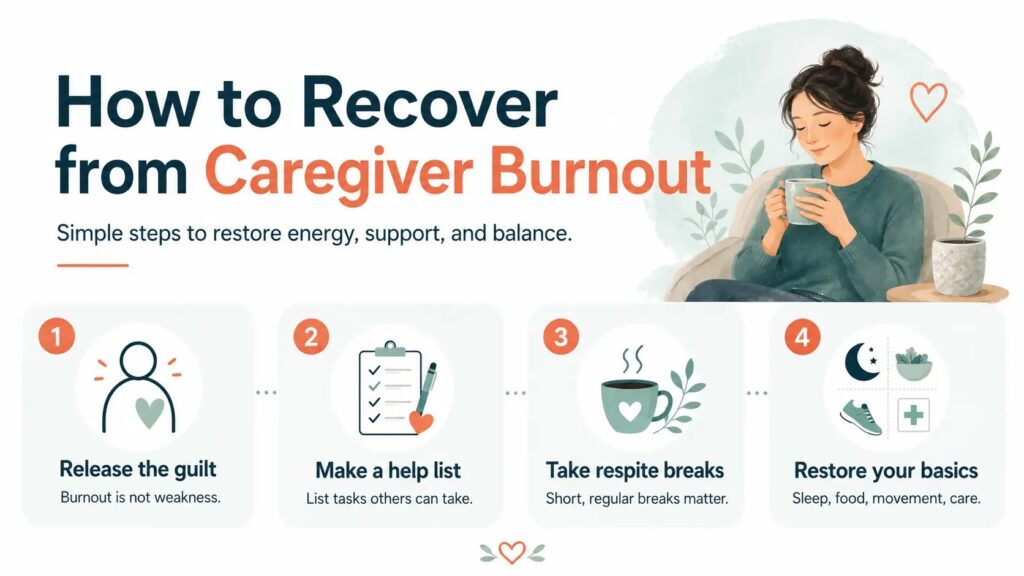
The five steps below are a framework that you can adapt to your situation, pace, and life.
Step 1: Admit That Burnout Is Not a Personal Failure
Many caregivers are taught to believe that feeling exhausted means they are weak or not doing enough, but that is not true.
Burnout happens when a person is under too much pressure for too long without enough support, not because of a personal flaw.
The guilt and feeling of “not doing enough” often come from how deeply they care, not from any lack of ability or effort.
Step 2: Make a “Help List” Before Asking for Support
Before reaching out to family, friends, or your broader network, sit down and create a concrete list of the tasks that could realistically be taken over by someone else.
The more specific the tasks, the easier it becomes for willing people to say yes.
Step 3: Use Respite Care or Short Breaks
Respite care refers to temporary, short-term relief care provided by a trained professional, a volunteer, or a care organization.
It allows the primary caregiver to step away for a period of genuine rest. Many caregivers resist respite care out of guilt or out of the belief that no one can care for their loved one as well as they can.
Short, regular breaks, even a two-hour walk, an uninterrupted afternoon, or a full evening off matter enormously when they happen consistently.
Step 4: Rebuild Sleep, Food, Movement, and Medical Care
Getting enough sleep, eating regular, simple meals, and doing light daily movement like walking or stretching can slowly restore your energy and mood.
It’s also important not to ignore your own health needs.
When to Ask for Professional Help?
You do not have to wait until you completely break down before asking for professional help. Early support can protect both you and the person you love.
1. When Burnout Starts Affecting Your Daily Life
It may be time to speak with a doctor, counselor, therapist, social worker, or care professional if burnout symptoms last more than a few weeks or continue getting worse.
This includes frequent crying, emotional numbness, constant exhaustion, ongoing resentment or anger, anxiety, hopelessness, sleep problems, or getting sick more often than usual.
It is also important to seek help if you have started neglecting your own health, skipping medical appointments, ignoring symptoms, or feeling unable to continue at the same pace.
2. When Care Becomes Unsafe or Too Complex at Home
Professional support may also be needed when your loved one’s care needs become too difficult for one person to manage.
This can happen when daily care involves frequent medication management, mobility support, fall risks, memory changes, personal care, nighttime supervision, or emotional and behavioral changes.
If caregiving has reached the point where you feel constantly worried about safety, mistakes, or your ability to keep up, it is a sign that more support may be needed.
3. What Professional Support Can Look Like
Professional help does not always mean making a major decision immediately.
It can begin with a simple conversation with a primary care doctor, therapist, caregiver support group, social worker, respite care provider, or senior care professional.
Gracious Hearts’ Gift of Love home in Phoenix was built for families facing this kind of moment.
Through personal care help, health and medication monitoring, housekeeping, social activities, Gift of Love helps families create a care plan that feels safe and easier to manage.
See how Gift of Love supports families.
The goal is not to replace your love or responsibility. The goal is to make caregiving safer, healthier, and more sustainable for everyone involved.
FAQ
Can caregiver burnout be reversed?
Yes, caregiver burnout can be reversed, but it takes time and consistent support. Recovery usually involves reducing caregiving load, getting respite care, seeking emotional support, and rebuilding basic self-care like sleep, nutrition, and rest.
What is the difference between caregiver stress and caregiver burnout?
Caregiver stress is the ongoing pressure from caregiving that can often be managed with coping strategies. Caregiver burnout involves deep physical, emotional, and mental exhaustion that affects daily functioning.
How long does caregiver burnout last?
There is no fixed timeline. Mild cases may improve in weeks with support and rest, while severe burnout can take months to recover.
Is caregiver burnout the same as depression?
No, burnout is tied to caregiving stress and may improve when the situation improves. Depression is a clinical condition that can exist independently and often requires professional treatment.
Can you continue caregiving while recovering from burnout?
Yes, but only with a reduced workload and strong support. Without adjusting responsibilities or adding rest and help, recovery becomes very difficult, and burnout may worsen.
Final Thoughts
Caregiving is one of the most selfless things a person can do. It asks everything of you, your time, your energy, your emotional reserves, your plans, and sometimes your sense of self.
A caregiver who is exhausted, isolated, physically unwell, and emotionally depleted cannot provide the same quality of care as one who is supported, rested, and resourced.
Throughout this article, we’ve walked through the most significant caregiver burnout signs and symptoms, from constant exhaustion and emotional overwhelm, to social withdrawal, sleep disruption, physical illness, and the quiet erosion of your own identity.
If you recognised yourself in any part of this article, take that recognition seriously.
One of the most effective steps caregivers take is transitioning their loved one to a trusted facility. Gracious Hearts’ Gift of Love home in Phoenix was built for families in exactly this moment.
Take care of yourself. Best of luck!